












Ebola travel ban in the US draws criticism from health authorities in Congo
Nations around the world are imposing strict entry restrictions on people who have recently been in the Democratic Republic of Congo because of a deadly Ebola outbreak in the country’s northeast.
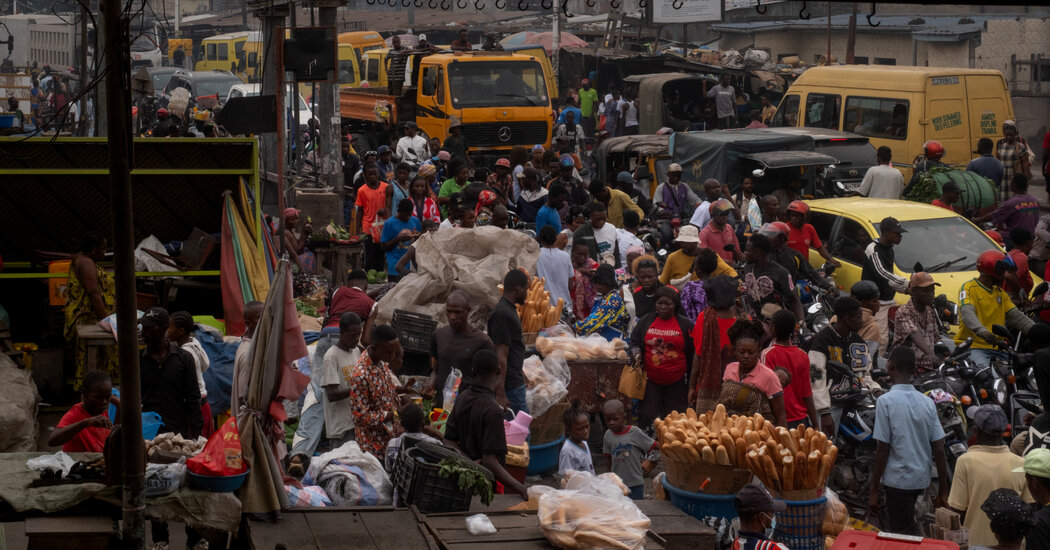
But in Kinshasa, the Congolese capital, most of the 20 million residents carry on as usual.
Open-air markets where traders sell cassava, fish, fruit and clothing remained crowded. Workers piled into taxis or hopped on their motorcycles for their morning commute on the heavily congested roads. Terraces and bars were full of guests drinking beer and eating grilled chicken with mayonnaise.
“I don’t know and I don’t understand why we should be afraid,” Malula Richard Esambo, the president of a soccer fans group in Kinshasa, said this week at an event in the city organized by the Congolese soccer association. “Kinshasa is safe for now.”
Covering more than 900,000 square miles, Congo is almost six times the size of California. The distance between the center of the Ebola outbreak, Ituri province in the northeast, and Kinshasa is about 950 miles, about the distance from New York to Orlando.
And there isn’t much traffic between Kinshasa and Ituri because of poor roads, reducing the chances of the outbreak spreading to the capital, said Tulio de Oliveira, the director of the Center for Epidemic Response and Innovation at Stellenbosch University in South Africa.
For this reason, said Dr. de Oliveira, it would be better for the United States to support affected countries to contain the outbreak at its source rather than “imposing a travel ban or isolation of all patients coming from such a large country.”
“I don’t think that’s a good public health response,” he added.
Still, some public health experts warn that far-flung places may not yet be safe as the virus has spread uncontrollably for weeks. There is no vaccine against this strain of virus, called Bundibugyo, and health authorities are still struggling to set up clinics in Bunia, the capital of Ituri.
On Friday, the governor of Ituri banned gatherings of more than 50 people and suspended a soccer match in Bunia. And on Saturday, the Congolese government announced that it would ban all air travel to and from Bunia and that relief flights would require special permission.
So far there have been 177 suspected deaths and about 750 suspected cases of the virus, which has spread in Uganda and South Sudan. Should it reach a megacity like Kinshasa with around 20 million inhabitants, it could pose significant challenges, as the dense urban environment and large population provide good conditions for rapid spread.
What reassures many Congolese is the fact that they have been here before.
This is the 17th Ebola outbreak to hit the country since the virus was discovered five decades ago. Despite all the challenges Congo may present, health authorities have extensive experience dealing with Ebola.
“Here people think it doesn’t affect Kinshasa,” said Christine Nlandu, 37, a vendor at a suburban market. “They think it’s a distant story.”
Petronella Mugoni, a social and behavioral epidemiologist who has worked in Congo, said she fears that some in Kinshasa have become complacent about Ebola because the city has not been badly affected by previous outbreaks.
It is critical for the government to step up its targeted public health information on Ebola, she said. But that can be difficult in a city where there are so many diseases that kill more people each year than Ebola, and where residents face a deluge of health information, she said.
Many people in Kinshasa may also find it difficult to focus on Ebola prevention if they rely on informal work to support their families, Dr. Mugoni.
“Even in the midst of challenges, making money is a priority,” she said. “A closure of the markets would be more catastrophic for many than Ebola.”
But residents of Goma, another large city, are not taking the Ebola outbreak lightly. Goma is the largest city in the east of the country and there is a lot of traffic between Goma and Ituri. In addition, Goma is currently under the control of the M23 rebel group.
“I am overwhelmed by the news,” said Joëlle Koko Zihindula, 28, a youth worker in Goma. “It’s depressing how conflict-filled the situation is.”
The Congolese government posted a message on social media emphasizing “the importance of maintaining preventive measures in response to the Ebola outbreak reported in Ituri.”
However, there were no public awareness campaigns targeting Kinshasa. There are no bans on large gatherings. The schools remain open.
The government has advised educators to remain vigilant and carry out awareness campaigns for their students, said Sister Elysee Ntoto Mazoba, the principal of Madame Lecandele School in northwest Kinshasa.
A Madame Lecandele student, Christopher Ciribagula, 9, has taken the awareness campaign to heart. He said he and other students were told to avoid touching dead animals, to tell their parents immediately if they had a fever and not to approach anyone with a bloody nose. “That means they have Ebola,” he said.
They were also encouraged to wash their hands frequently, Christopher said. He said he wasn’t looking forward to an upcoming family trip because he didn’t want to come into contact with anyone who might be sick. “I am very afraid of this disease,” he said. “If this disease ever reaches Kinshasa, where we live, it could be dangerous for the entire city.”
Not all concerns related to Ebola are life and death.
Some soccer fans fear they could be barred from entering the United States to support their team at the World Cup. Congo is scheduled to play its first game on June 17 in Houston. Mr. Esambo, the fans group’s president, has tried to allay those fears by saying that the visa process was already underway and he was confident that American authorities would allow them to enter the United States.
“America is a great country,” he said. “Making such unfounded decisions would not be a good move.”
Arlette Bashizi contributed reporting from Goma, Democratic Republic of Congo, Lynsey Chutel from London and Zimasa Matiwane from Johannesburg.


