














Trump says the US will continue talks with Iran but the ceasefire is over
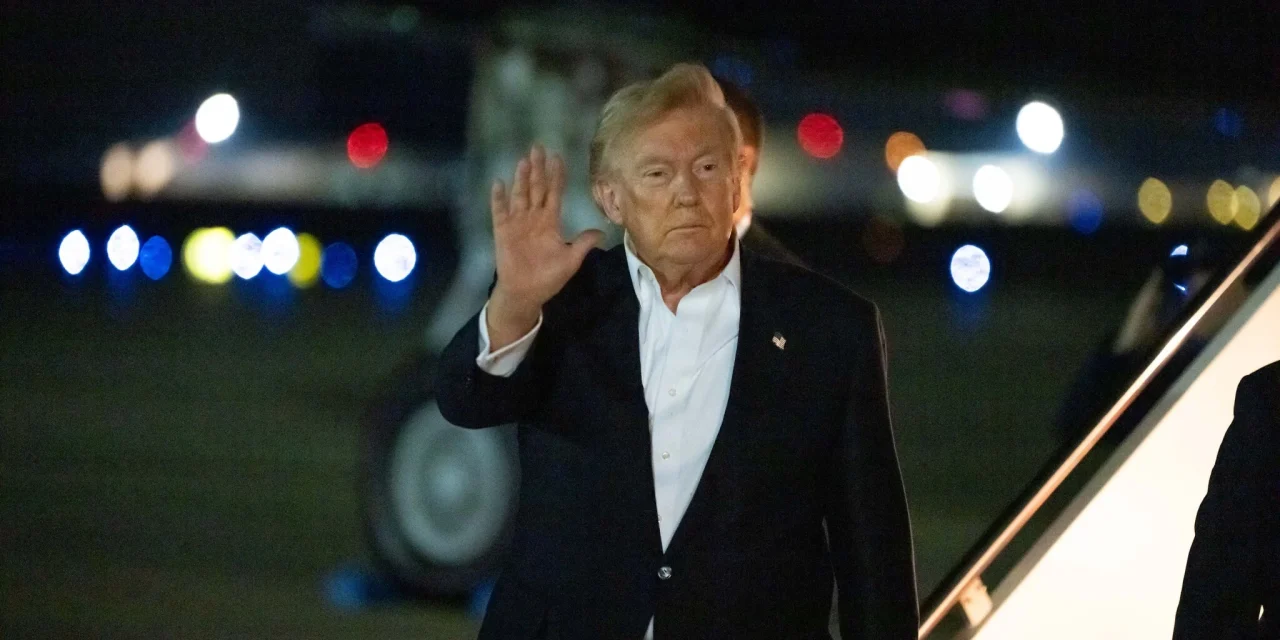
US President Donald Trump said on Friday the US had agreed to continue talks with Iran but reiterated that the ceasefire with Tehran was over as Iran threatened to expand its retaliatory attacks on targets in Israel.
“The Islamic Republic of Iran has asked us to continue the ‘talks’.” We agreed to this, but the United States told them in no uncertain terms that the ceasefire is OVER!” Trump wrote on his Truth Social platform.
But the impact of the statement was unclear, especially given that the White House signaled Thursday evening that it was willing to abide by the terms of the memorandum of understanding it signed with Iran last month if Tehran did the same.
The Truth Social post came amid reports that Qatari, Pakistani and other mediators have sought to quell the US-Iran conflict and prevent the MOU from completely collapsing.
A Qatari delegation visited the Islamic Republic on Friday, the semi-official Iranian news agency Tasnim reported. Axios reported that the visit was coordinated with the US and quoted a diplomat as saying: “It is clear that both sides want to return to the MOU.”
Get the daily edition of The Times of Israel
by email and never miss our top stories
By registering you agree to the terms and conditions
According to Axios, negotiators believed the U.S. and Iran had made progress toward a nuclear deal in talks before the outbreak.
In this photo released by the Office of the Supreme Leader of Iran, mourners sing and raise their fists during the final mourning ceremony for the late Supreme Leader of Iran Ayatollah Ali Khamenei at the Imam Reza Shrine before his funeral in Mashhad, northeastern Iran, July 9, 2026. (Office of the Supreme Leader of Iran via AP)
In response to US attacks, Iran threatens to attack Israel
Hours before Trump’s social media post, the secretary of Iran’s Supreme National Council threatened to target Israel in response to American attacks.
“As we have already announced, there will be retaliation for any attack on infrastructure, and the criminal Zionist regime responsible for these atrocities will not be spared from the response of our fighters,” Mohammad Bagher Zolghadr said in a statement on state television.
Iran’s Mohammad Bagher Zolghadr in 2023 (YouTube screenshot/CCTV)
In Israel, public broadcaster Kan reported that some in Jerusalem wanted to renew attacks on Iran but were waiting for Trump’s approval to do so.
According to the unsourced report, officials in Jerusalem expected mutual attacks between the US and Iran to continue in the coming days.
Similarly, the New York Post quoted a Jerusalem source as saying Israel was interested in joining future attacks and fully renewing the war.
“We are ready to do it again if necessary,” the unnamed source was quoted as saying on Wednesday, before the US began attacking Iran.
The source added that while Israel is “not ready to return to the day when people have to go to shelters,” it also does not want to “ignore what is happening in Iran.”
“So if that is the price we have to pay, we will endure this situation.”
A sign directs passengers to a bomb shelter at Israel’s Ben Gurion Airport, June 8, 2026. (Avshalom Sassoni/Flash90)
The latest escalation was triggered by attacks on ships in the Strait of Hormuz that Washington said were carried out by Iran, renewing concerns about the recovery of global oil shipping after a months-long war-related closure of the vital waterway.
While the recent shooting was limited to the Gulf, Jerusalem is preparing for multiple scenarios amid fears the situation could quickly deteriorate, Channel 12 reported.
The fighting, which began on February 28 with US-Israeli attacks, reached a ceasefire on April 8 and the US and Iran are holding talks based on the memorandum of understanding agreed last month.
Israel is not involved in the memorandum or the talks, and Israeli officials have criticized the document for failing to secure a concrete concession from Iran regarding its nuclear program.
In the memorandum of understanding, the sides agreed to reopen the Strait of Hormuz free of charge for 60 days, but Iran claims the document still gives it the right to manage shipping through the corridor.
International shipping group rejects Iran’s strait ‘authority’
Protecting shipping lanes was discussed this week at a meeting of the 40-member governing council of the London-based United Nations International Maritime Organization, where Gulf states, the United States and Iran argued over the future of the strait.
The IMO Council adopted a non-binding decision and said it condemned “in the strongest possible terms” Iran’s decision to “establish a body purporting to control traffic through the strait.”
At the conclusion of the 137th session of the IMO Council, @IMOSecGen thanked the delegates for their commitment. Member States adopted a Council resolution reaffirming the IMO’s support for the protection of vital shipping routes and the right of transit through international straits. https://t.co/bGQdXwwinX pic.twitter.com/YqDruEMXtS
– International Maritime Organization (@IMOHQ) July 10, 2026
The resolution called on member states not to recognize “Iran’s claim to sovereignty over the Strait of Hormuz and its claims of sovereignty over the maritime zones of third States in and around the Strait, which violate the sovereignty, sovereign rights and exclusive jurisdiction of these States,” and not to recognize Iranian decisions that seek to “block, impede, impede or otherwise impair international navigation and the right of transit passage.”
Iran’s recently established Persian Gulf Strait Authority said in a statement last month that no ship would be allowed to pass through the waterway “without a valid transit permit issued by the authority.”
Iran, which does not have a seat on the council, told IMO delegates this week that it had rejected “the selective, politically motivated and legally baseless allegations” against the country. It added that its moves were intended to “protect Iran’s sovereignty and vital security interests” and “do not constitute a closure of the strait.”
Russia suspends the return of workers to the Iranian nuclear power plant
Russian state nuclear company Rosatom said on Friday it had suspended the return of its first employees to the construction site for new units at Iran’s Bushehr nuclear power plant following new attacks on Iran.
An Iranian official told state media on Thursday that a projectile struck the perimeter of the facility and hit a military site on the outskirts of Bushehr.
A worker rides a bicycle in front of the reactor building of the Bushehr nuclear power plant, just outside the southern city of Bushehr, Iran, October 26, 2010. (Majid Asgaripour/Mehr News Agency via AP)
“A few hours ago, the first group of people – six people – began their journey to the construction site, but after the attacks that took place last night, we stopped the advance of our team in Tehran,” the head of the Russian state-owned company, Alexei Likhachev, was quoted as saying by Russian news agencies.
“We will decide on the next steps in the near future,” he said.
Rosatom, which is building two new plants in Bushehr, evacuated more than 600 employees to Russia after the US-Israeli war with Iran began on February 28. Some of them returned and arrived in Tehran, where their further journey to the power plant was put on hold.
The Russian state nuclear company has left just 20 employees there to keep construction going and has said expanding the plant remains one of its priorities.
We cannot do this work alone.
The war with Iran was a burden for all of us in Israel. But when I heard about a high-casualty incident—ballistic missile strikes in Arad and Dimona that injured nearly 200 people—I drank a cup of coffee, packed a bag, and headed south.
There I spoke to Shilgit, the head of an after-school program for disadvantaged young people. Standing in front of her destroyed center, Shilgit said it was a miracle that no children had been hurt and spoke of how the community had come together in the hours since.
As a reporter for The Times of Israel, I am committed to telling stories of resilience like Shilgit’s. But my colleagues and I cannot do it alone. If you value such work, Please consider joining our reader support group, the Times of Israel Community. Your financial support is essential to sustaining truly human reporting like this.
— Stav Levaton, military reporter
Yes, I will join. Yes, I will join. Already a member? Log in to stop seeing this


