
















Triggered by record antisemitism, local Jews put stock in LA-based security nonprofit
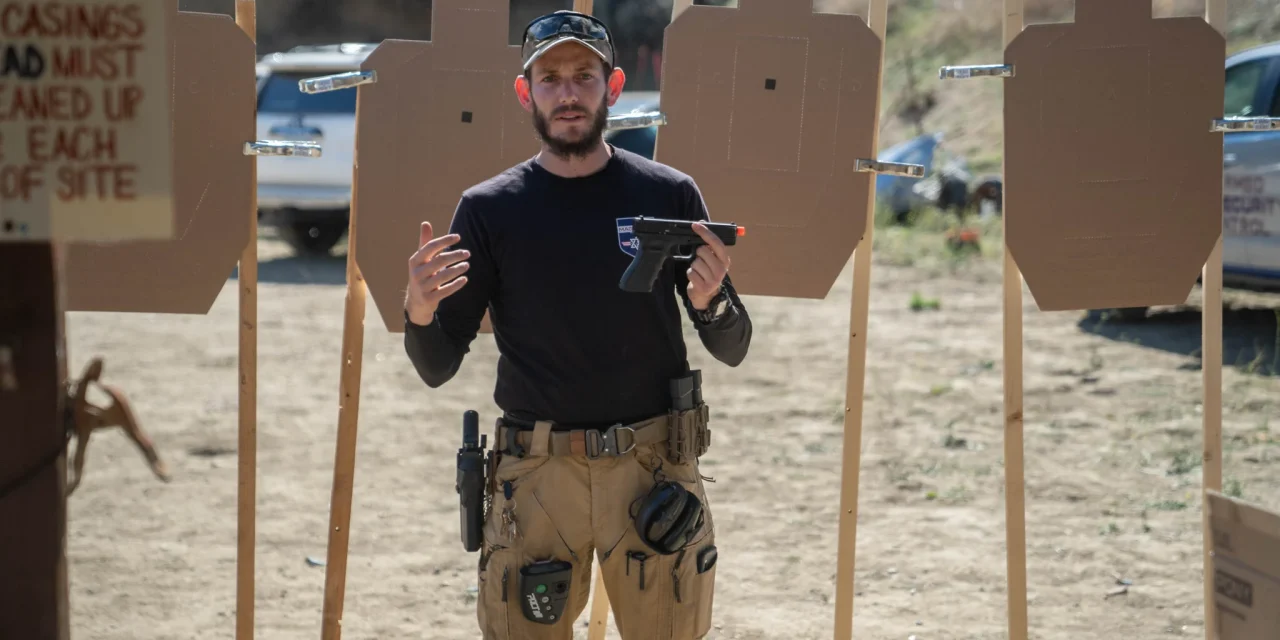
PIRU, California — Early on a Sunday morning in Piru, California, about a 45-minute drive northwest of Los Angeles, about a dozen people geared up to begin target practice at the largest outdoor shooting range in the vicinity.
Tucked in a beautiful mountain range and spanning over 1,500 acres with over 50 shooting bays, the firing ground was a good base for Magen Am, an LA-based security nonprofit that trains volunteers in the use of firearms and community safety.
Among those participating was Erik Huberman, the 38-year-old founder and CEO of a successful marketing agency, who has been training for nearly a decade.
Huberman purchased his first gun eight years ago, “just in case,” hoping he would never have to use it.
“It seems like throughout my childhood, antisemitism was something distant, like a skinhead in Kentucky. It wasn’t something I had to worry about. And then suddenly, it’s everywhere,” Huberman said.
“Over the past two years, it’s been perpetuated in such a way that even my own social media posts reflect how blind people have become to it,” he said. “I’m posting how the Jewish community should learn how to protect itself, and I get hate messages like, ‘Neo-Nazi freak.’”
Since the bloody Hamas-led invasion of Israel on October 7, 2023, which sparked the war in Gaza, bringing with it a worldwide spike in antisemitism, the number of people purchasing guns in the Jewish community has risen. As a result, the shooting range in Piru has grown accustomed to seeing a different kind of clientele — men with kippas and women in headscarves, long-sleeve shirts, and modest skirts.
A member of Los Angeles-based security nonprofit Magen Am wraps tefillin at the firing range. (Courtesy of Magen Am)
In 2016, Rabbi Yossi Eilfort, then only 24 years old, co-founded Magen Am, which has grown over the past decade to offer security services for the Jewish community in Los Angeles, including 42 schools and synagogues.
It now offers private firearm training sessions, carrying a concealed weapon classes, guard services, and self-defense classes, among other services.
After seeing a post by Eilfort on Instagram, Huberman decided to sign up. Since then, he has brought along his wife and dozens of friends, encouraging them to learn gun safety and proper use.
Erik Huberman, a member of Los Angeles-based security nonprofit Magen Am, at the firing range. (Yoni Coen)
“I’ve gotten phone calls from people asking, ‘Can you lend me your gun and teach me how to shoot?’” Huberman said. “I tell them, I can’t lend you a gun — it’s illegal. But I can set up a class where you can learn safety and how to shoot properly.”
For Huberman, going to the shooting range has become part of his weekly routine — something he can do after putting the children to sleep and having some free time for himself.
“I’d rather this would be something I do as a hobby that would never become useful,” he said.
None of the people at the Sunday class had ever experienced a violent antisemitic attack firsthand, though they had heard about them in the news and knew of others who had been assaulted simply for being Jewish.
“A lot of what we do is teaching people how to avoid problems before they happen,” said Eilfort. “It also gives them confidence, knowing that they would be able to defend themselves if necessary.”
Some participants have even become volunteers with Magen Am, patrolling the streets and maintaining a visible presence in Jewish neighborhoods and outside synagogues. This visibility, they believe, acts as a deterrent to would-be attackers.
A member of Los Angeles-based security nonprofit Magen Am provides security at an event. (Courtesy of Magen Am)
“A year after October 7, we doubled our number of volunteers, and this year we doubled that number again. It’s really opening up, and we’re trying to bring even more people through the pipeline,” said Eilfort. “People want to do this for the community. We need to get our message out there — specifically, we want to reach the Israeli community. They have served in the IDF, and they are exactly the kind of people that the community can benefit from.”
A growing threat
In the past, members of the Jewish community have reported being attacked on the street unprovoked.
In August, 24-year-old Ariel Yaakov Marciano was assaulted on the Santa Monica Pier by a group of around 20 men carrying Palestinian and Mexican flags. Marciano, an Israeli visiting town for his cousin’s bar mitzvah, had his Star of David necklace ripped from his neck and was repeatedly punched in the head.
Illustrative: Los Angeles Mayor Karen Bass, at podium, addresses community members and other local, state law enforcement officials in a town hall on antisemitic violence at YULA Boys High School in Los Angeles, February 20, 2023. (AP Photo/Damian Dovarganes, File)
Just a week earlier, three Israeli men were attacked while walking home from synagogue. After reviewing the video Marciano recorded of his assailants, one of the Israeli men, Eyal Dahan, identified members of the same group that had targeted him.
Despite police being present in the area, no arrests were made.
Antisemitism in the United States has risen sharply over the past seven years, with the trend accelerating dramatically since October 7. According to the FBI’s annual Hate Crime Report, published in August 2025, the year 2024 saw a new high in antisemitic incidents in the United States, with a total of 1,938 antisemitic hate crimes.
The Anti-Defamation League has a higher tally, likely because it counts all reported incidents and not only those for which a police report is filed. The watchdog recorded over 10,000 antisemitic incidents in the US between October 7, 2023, and September 2024, marking a 200% increase compared to the previous year and the highest annual total since tracking began in 1979.
Surveys reflect the impact of this surge on American Jews: a Combat Antisemitism Movement study found that 61% of Jews in the US — approximately 3.5 million people — experienced antisemitism since October 7, while the American Jewish Committee reported that 77% of Jews feel less safe, 56% have changed their behavior out of fear, and 90% believe antisemitism has increased. The ADL also noted that antisemitic incidents on college campuses rose 84% in 2024, affecting an estimated 83% of Jewish students.
Members of Los Angeles-based security nonprofit Magen Am engage in target practice at the firing range. (Courtesy of Magen Am)
The report further noted that, although Jews constitute only 2% of the US population, they were the target of 69% of all religion-based hate crimes.
Comrades in arms
Magen Am exists alongside a number of other national security and self-defense organizations. The Secure Community Network, founded in 2004, is a nonprofit that serves as the official safety and security arm of the organized American Jewish community, coordinating threat monitoring, intelligence sharing and training in partnership with law enforcement.
The Community Security Service, launched in 2007, takes a more grassroots approach, recruiting and training volunteers to provide protective presence at synagogues and communal events. Together, the two models illustrate how Jewish institutions nationwide have professionalized and decentralized security efforts over the past two decades.
Anti-Israel protesters set up tents in front of Sproul Hall at the University of California, Berkeley, in Berkeley, California, May 2, 2024. (AP Photo/Jeff Chiu)
Another community-based security group in Los Angeles is Shmira Public Safety, a nonprofit volunteer organization founded in response to rising crime in Jewish neighborhoods. Their mission is similar to that of Magen Am — deterring crime through visible patrols, community engagement, and close cooperation with law enforcement and other public safety organizations.
Volunteers, both men and women, provide a constant presence in neighborhoods such as Pico-Robertson, Hancock Park, and the Valley, and are available through a 24/7 dispatch line.
Unlike Shmira, which relies entirely on unpaid community volunteers to safeguard local businesses, synagogues, schools, and homes, Magen Am stands out as the only Jewish nonprofit on the West Coast that provides armed physical security.
Rabbi Menachem Creditor, founder of Rabbis Against Gun Violence, said that Jewish tradition “has always affirmed the ethical mandate of self-defense.”
“My experience has taught me that training and responsibility are the only appropriate ways for anyone to ever purchase a firearm,” Creditor told The Times of Israel. “It needs to be handled under communal level as well with great care and sensitivity, because the presence of a firearm greatly increases the chances of bloodshed.”
As such, said Creditor, “Our communal agencies… are important places for our leadership and community members to refer to if they are considering purchasing firearms.”
In a recently released best practices white paper, the SCN highlights Magen Am as one such model for community-based armed volunteer security. According to SCN’s national director and CEO, Michael Masters, the decision to feature Magen Am was based on several key factors that set the organization apart.
“Magen Am is a rigorously structured, standards-driven initiative,” Masters told The Times of Israel. “Volunteers are selectively recruited, recommended by rabbis, thoroughly vetted, and required to obtain both the California armed guard card and a concealed carry weapons license.”
Rabbi Yossi Eilfort, founder of Los Angeles-based security nonprofit Magen Am, gives a lesson to members of the group at the firing range. (Yoni Coen)
Masters emphasized that Magen Am’s close coordination with law enforcement and public safety agencies ensures smooth communication and prevents confusion — a level of collaboration that many communities struggle to achieve. He also pointed to the program’s replicability, noting that Magen Am provides a clear blueprint for other cities looking to build disciplined, community-based volunteer security teams.
“Magen Am shows that armed volunteer security can be done thoughtfully, responsibly, and in true partnership with broader public safety,” Masters said. “They’ve built a structured, standards-driven model that gives volunteers the tools and training they need to deter and respond to real threats facing Jewish institutions.”
The organization also distinguishes itself from catchily-named Jewish gun clubs, such as Bullets & Bagels or Lox & Loaded, which are primarily geared toward honing skills.
Roberta Tarnove at a shooting event with Bullets & Bagels. (Courtesy Roberta Tarnove via JTA)
“Magen Am is not a gun club,” Eilfort said. “We are a community security organization building a structure for a sustainable, secure Jewish future. We are all about service and supporting a thriving community.”
“We serve different goals, and have intentionally been in communication with the directors of the other programs because we believe we should be able to coexist, with several individuals likely becoming members of multiple social circles,” he said.
LA resident Anna Schwartz said she decided to purchase a gun after her friends and neighbors did.
“My grandparents were Holocaust survivors,” said the 52-year-old. “They told me about all the signs they saw before being sent to the concentration camps, but they chose to believe it would go away, that they would be fine. I found myself acting the same way, thinking it would be okay. I was never afraid to wear a Star of David necklace. But I realize ignoring the signs is not an option. Until now, it might have happened to someone else, but tomorrow it might be me.”
Schwartz purchased a Glock 19 handgun and began training. She is now able to shoot straight into the cardboard target and not the hills behind it.
Lox & Loaded members learn how to use firearms at a shooting range. (Courtesy Lox & Loaded via JTA)
Eilfort said he sees mostly middle-aged adults attending the training, but also some younger people in their 20s.
“For me, it’s very powerful to see the community coming together like this,” said Eilfort. “They’re feeling called to it. I think many people take everything happening in the world to heart. They take it personally when a Jewish man or woman is attacked.”
Eilfort was an assistant rabbi at Chabad of the Pacific Palisades and a teacher at the Cheder Menachem day school in Los Angeles before founding his nonprofit organization. He now works full-time as the CEO of Magen Am.
In recent years, Magen Am has extended its reach to Orange County and Phoenix, Arizona.
A member of Los Angeles-based security nonprofit Magen Am provides security at an event. (Courtesy of Magen Am)
“We have 11 active members in Orange County, and 10 active members in Arizona,” said Eilfort. “Several of these team members also give their time to respond to incidents in their area as part of our emergency responders program.”
Eilfort is familiar with the many reports tracking the rise of antisemitism in the US — but he refuses to let these grim statistics discourage him.
“A lot of people say antisemitism is so bad now, but we have to remember that we are living in better times than we had in a very long time,” he said. “We are at a point in history where we have both the option and the opportunity to build a more secure future. We see the trend, and instead of waiting until it’s too late, now is the time for people to get involved.”
