
















Taylor Farms expands iceberg lettuce recall to 27 states due to Cyclospora outbreak
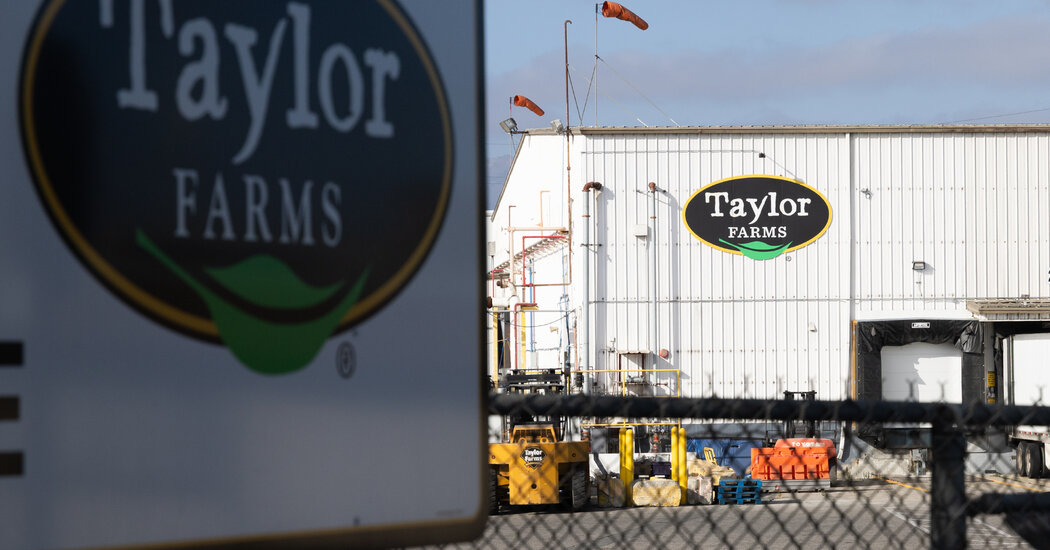
Grocers and retailers rushed to pull products containing iceberg lettuce from shelves Saturday as Taylor Farms issued a recall, informing customers that lettuce shipped to 27 states may be contaminated.
The country’s largest food company is under scrutiny after federal officials linked the company’s Mexican plant to an outbreak of illness caused by Cyclospora, a parasite that can cause serious illnesses such as vomiting, convulsions and explosive diarrhea.
The Centers for Disease Control and Prevention investigation initially linked the parasite to lettuce that Taylor Farms delivered to Taco Bell in five states earlier this week. However, Taylor Farms’ recall notice late Friday suggested a far greater spread of potentially contaminated green spaces.
The recall may not end current problems for Taylor Farms.
Late Saturday, the Food and Drug Administration said a sample of iceberg lettuce from Taylor Farms de Mexico tested positive for Cyclospora as part of “targeted import surveillance.” The agency said Taylor Farms has confirmed that the positive product is not part of the current recall and that the company is trying to determine whether the new affected batch reached restaurants or consumers’ homes.
Taylor Farms did not respond to an email seeking comment on Saturday, but said Friday that it had “suspended distribution of iceberg lettuce from central Mexico.”
The recalled products were shipped from June 29th through Thursday and have an expiration date of August 3rd. Taylor Farms said on social media that none of its own Taylor Farms brand salad kits have been linked to the outbreak.
Instead, much of the recalled product was sold in larger bags to food service establishments such as restaurants. Many of the bags were mixed with romaine.
States listed under the recall include Florida, Illinois, Texas, Pennsylvania, New Jersey, North Carolina and Missouri. The recall notice does not list California or New York, but it is unclear whether Taylor Farms supplied lettuce to companies in the states affected by the recall and those companies then distributed the lettuce widely.
The size and scope of the outbreak — which may have affected more than 5,000 people in at least 34 states — led to widespread panic among consumers this week. The uncertainty was fueled in part by government investigators’ struggle to identify the source.
But consumer confusion about where their salad comes from is also a result of an opaque food system. Taylor Farms, like other food manufacturers, does not disclose which grocery stores or restaurants it distributes leafy greens or other vegetables to.
Even the company’s recall notice was vague. Instead of providing the names of distributors or stores that received the recalled lettuce, Taylor Farms used codes.
Nevertheless, several companies contacted said on Saturday afternoon that they were withdrawing the affected product from their supply chains or stores.
Retail giant Walmart said it had removed some salads from its Marketside brand, although there were no signs the products were affected.
“Out of an abundance of caution, customers who purchased these products should not consume them and should throw them away or return them to their local Walmart store for a full refund,” the company said.
(The FDA flagged Walmart’s Marketside products in its update late Saturday afternoon.)
Sysco, the country’s largest grocer, said it had withdrawn all iceberg lettuce products from Mexico at the request of Taylor Farms.
“We will continue to actively monitor the situation and work with regulators as necessary,” Sysco said, adding that sales and distribution of these Taylor Farms products were suspended on Thursday.
US Foods, another major grocer, said it also notified affected customers of the recall on Friday, a spokeswoman said in an email.
Jack and the Box restaurants learned of the possible problem with their lettuce on Thursday and immediately asked restaurants that received the affected shredded iceberg lettuce to discard it. According to the company, the affected restaurants were in Texas, Oklahoma and Louisiana. “At this time, there are no known illnesses associated with food served at Jack in the Box related to the ongoing FDA investigation,” the company said.
Taco Bell, which moved quickly this week to pull lettuce from restaurants in some states, said in a statement Saturday afternoon that it had adjusted its supply chain and “voluntarily removed all affected Taylor Farms lettuces” from every Taco Bell restaurant in the country within 72 hours.
“This is clearly a nationwide industry-wide issue and not a Taco Bell-specific issue,” the statement said. “We hope that other members of the industry take the same level of immediate action and responsibility to the consumer as we do.”
In fact, it’s likely that other retailers and restaurants are also affected by the recall and may not come forward.
Although information was released later Saturday, the FDA said on its website that morning that Taylor Farms “has not provided public sales information or a list of customers who received the product that was voluntarily withdrawn from the market.”
FDA regulations do not require the company to do so, which is a source of frustration for food safety executives.
“Food safety advocates have called on the FDA over the years to make this a requirement,” said Sandra B. Eskin, executive director of Stop Foodborne Illness, an advocacy group. “Without this essential information, a recall will not be effective.”
She added: “It’s about identifying the product quickly and making sure no one else eats it.”
Although there may be thousands of cases, the CDC has officially confirmed that at least 1,645 people have become ill and 141 have been hospitalized, most of them after eating the salad sent to Taco Bell. The CDC made this determination through scientific detective work, from case reports of sick people to tracing a common food source. The number of cases will likely rise as the CDC considers the scope of the recall.
The United States is on track to see more Cyclospora cases in 2026 than any previous year. The agency said it was investigating more than 5,100 other illnesses that may have been caused by the parasite, which is transmitted through food or water contaminated with feces.
On Thursday evening, Taylor Farms executives met with the White House and the Food and Drug Administration to try to distance the company from the outbreak and address concerns about the official investigation into the outbreak.
On Friday, the company said the information provided by the FDA led the company to withdraw its iceberg lettuce from the market. The company said its Mexican processing plant, Taylor Farms de Mexico in Guanajuato, is voluntarily removing all iceberg lettuce grown in central Mexico.
The FDA plans to inspect the Guanajuato facility in the coming days to determine how the Cyclospora parasite got on the lettuce and trace it through the supply chain.
Alice Callahan contributed reporting.


