

















As screwworm cases rise, U.S. officials are ramping up the response
The U.S. Department of Agriculture reported three new cases of the New World screwworm on Monday, including the first cases in dogs and goats, bringing the total number of cases in the country to five. She also pledged to intensify and accelerate efforts to control the screwworm, a parasitic fly that the country declared eradicated in the 1960s.
At a news conference Monday, federal and Texas state officials said they are using artificial intelligence-based technology to monitor screwworm populations, train ranchers to detect infections in their livestock and increase the number of facilities that produce and distribute sterile flies, which are the primary tool for controlling screwworms.
Officials are also considering granting emergency use authorization to a new strain of genetically modified flies that could make the production of sterile flies faster and more efficient.
“We have prevented and eradicated this pest before,” Gov. Greg Abbott, Republican of Texas, said during the briefing. “We can do it again.”
The three new cases were identified in a calf in La Salle County, Texas; a goat in Gillespie County, Texas; and a dog in Lea County, NM It is not clear whether the dog acquired the parasite in the United States; Although officials initially suggested the dog may have recently been in Mexico, they later said its travel history was unknown.
The agency reported the first two cases last week, both in calves in Zavala County, Texas.
Still, Agriculture Secretary Brooke Rollins noted during the press conference that the reemergence of the New World screwworm is not unexpected.
For several years now, the insect has been traveling north through Central America. Ms. Rollins credits surveillance and containment efforts with slowing the spread of the pest in Texas.
“Every model showed that the New World screwworm would be here in Texas early last summer, so we bought an extra year to prepare for that moment,” Ms. Rollins said.
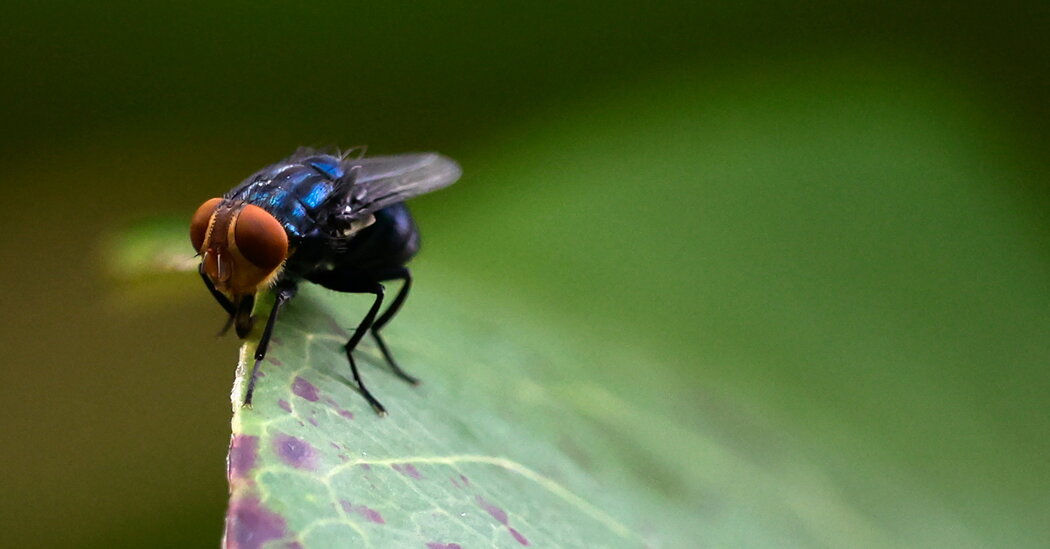
The New World screwworm is a blowfly that feeds on living flesh. Adult females lay their eggs in open wounds or orifices of warm-blooded animals. When the eggs hatch, the larvae burrow into the wound and eat the animal’s tissue. If left untreated, snailworm infections can kill animals within a week.
Snailworm infections are rare in humans. Last year, American health officials confirmed a travel-related case in a Maryland resident who had recently traveled to El Salvador, but no domestically acquired cases in humans have been reported.
The parasitic fly was a serious nuisance to livestock in the southern United States in the early 20th century. Officials eradicated it using the sterile insect technique, which involves breeding huge numbers of flies, sterilizing them with radiation and then releasing them into the wild. The screwworm population declined sharply as wild females, which only mate once in their lives, reproduced with the infertile males.
The technique relies on the release of sterile males, but separating male and female flies produced in mass rearing facilities was not practical. Consequently, both male and female flies are typically reared, sterilized and released.
A male-only strain would make the approach far more efficient. Recently, scientists have made progress in creating an all-male strain using NovoFly, a genetically modified version of the New World screwworm.
“This will allow us to almost instantly double the number of sterile flies we send into combat,” Scott Hutchins, USDA undersecretary for research, said of NovoFly at Monday’s press conference.
The NovoFly contains genes for two unusual proteins. In men, these proteins have few known effects other than sterility. However, they cause females to die in the embryonic stage, so the only NovoFly that reaches adulthood – unless tetracycline, an antidote to the genetic modification, is given – is an infertile male.
“It has never been tested in the field, and this has to be the next step,” said Maxwell Scott, an entomologist at NC State University whose lab helped develop the NovoFly.
NovoFly is considered a pesticide; It is usually subject to a lengthy approval process before it is released into the environment. However, because of the health and economic risks associated with a screwworm outbreak, the Environmental Protection Agency is considering a waiver that could speed up the release.
This means the NovoFly could be one of the few genetically modified animals released into the wild. In 2006, a modified version of the highly invasive pink bollworm was released in Arizona. More recently, the Oxitec mosquito, designed to curb the spread of malaria, Zika, yellow fever and other diseases, has been released in mosquito-infested areas of the world, including the Florida Keys.
It is not yet clear whether NovoFly’s emergency exemption will be approved, but the USDA has made clear that it will continue to support the effort, as well as others that could bring the United States closer to completely eradicating the screwworm.
“We will turn over every stone to find more sterile flies,” John Bellinger, the USDA’s senior advisor for New World snailworm preparedness, said during Monday’s briefing. “We have to be ready next spring.”


