















An effective HIV drug ends up in Zambia. But will it reach those who need it?
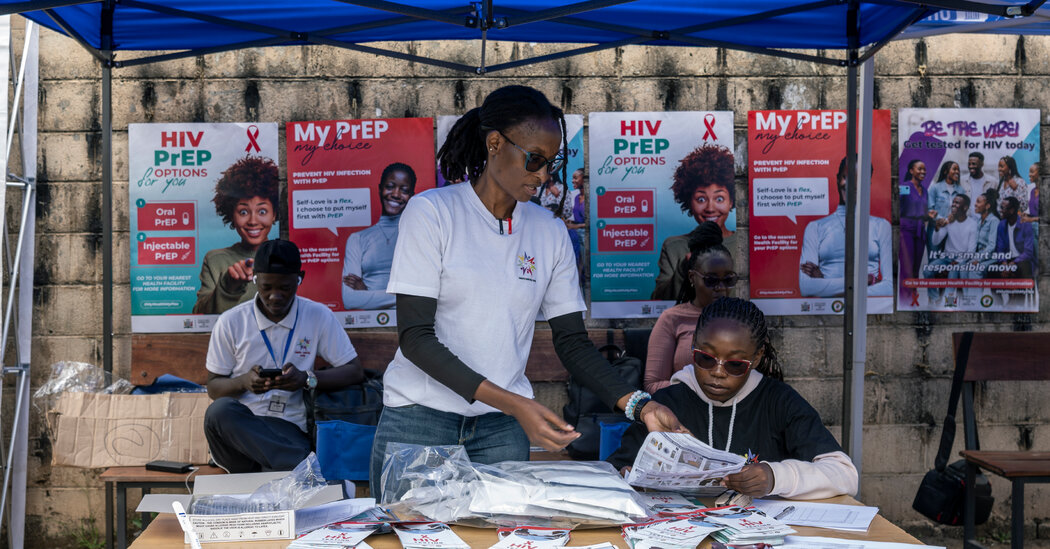
On a sultry morning in March, dozens of freshly minted student recruiters streamed into dormitories on the University of Zambia’s sprawling leafy campus. They walked past piles of papers, laundry, and instant noodle packets and pounced on any classmate who slowed down long enough to listen to their lecture:
“Come along immediately and get an injection! It will protect you from HIV infection for the next six months. It takes two minutes! And it’s free!”
It was an early experiment to deliver the most scientifically advanced weapon available in the fight against HIV, targeted to the people who need it most: young African women, who are statistically at greater risk of contracting the virus than anyone else in the world.
Soon a line formed and the students went one by one into a small room, pulled up their T-shirts and received two injections on either side of their navels of a drug that prevents infection in HIV-infected people
For the researchers, clinicians and health officials who gathered on the sidelines to watch, it was a hopeful moment at a time when Zambia’s HIV response has been severely hurt by the Trump administration’s foreign aid reform.
In clinical trial results published in 2024, the drug called lenacapavir showed an astonishing 100 percent protection against infections in patients who received injections every six months. Since then, there has been a concerted effort to bring the drug to sub-Saharan Africa.
When the Trump administration made significant aid cuts last year, there were fears that it would not follow through on its Biden administration commitment to bring lenacapavir to developing countries. But the State Department has not only fulfilled this commitment, but has also recently increased investment. The ministry said it would work with an international health organization to finance the purchase of enough medicine to reach three million people by the end of 2028.
“This is a really exciting opportunity to actually change the curve of the epidemic,” said Jeremy Lewin, the State Department’s top foreign assistance official, when he announced the expanded commitment last month. He added: “Lenacapavir is one of the best ways to actually end the disease.”
Still, it’s far from clear whether distribution of the drug will deliver on its full promise of finally ending the HIV epidemic here. The Trump administration’s other aid cuts have left the country’s health care system so vulnerable that it may not have the infrastructure necessary — to run tests, deliver the drug, maintain records — to get the drug to everyone who needs it. And it’s not clear whether Zambia will receive enough donated doses – or be able to buy enough – to have a meaningful impact on HIV transmission rates.
Gilead Sciences, which developed lenacapavir, sells the drug in the United States for more than $25,000 per patient per year. But Gilead has also licensed several generic drugmakers to produce it, and they are expected to offer it starting in 2027 for about $40 per person per year. Meanwhile, Gilead makes the drug at a profit-free rate (estimated at about $100 per person per year). The Global Fund to Fight AIDS, Tuberculosis and Malaria and the United States HIV program are providing it in eight developing countries so far, with plans to reach 24 countries by the end of this year.
Zambia was one of the first two countries in Africa to receive lenacapavir and began offering it to women in December at a maternal health clinic at the national teaching hospital in Lusaka.
On a March morning, stressed-out nurses at the clinic weighed patients, checked blood pressure, listened to fetal heartbeats, examined newborns and tested for HIV. And they explained lenacapavir.
“A lot of women really want to try it,” said Dr. Suilanji Sivile, the technical director of the national HIV program. But the clinic only gives it to a select few each week because they are unsure how much of the drug Zambia will receive and when it will arrive. The upheaval in aid relations with the United States has clouded the planning and timing of delivery.
“You can’t start someone on treatment without knowing that you can give them the next dose when they come back in six months,” Dr. Sivile.
Mavis Mwanza, 19, was one of the women who made it in March. Four months into her first pregnancy, she heard about lenacapavir on social media and thought it was a good idea. She lives far from the hospital, she said, so it would be a relief if she could get HIV prevention once at this appointment and then not think about it again for months.
Ms. Mwanza received her first dose of lenacapavir (actually two injections plus two tablets that a patient takes when receiving the drug for the first time) from a midwife in a clinic room that was so small that the door could not be fully opened.
Glenda Malyangu, the nurse who oversees the clinic’s HIV program, looked over the top of her glasses at benches full of women, many of them holding newborns wrapped in blankets.
She wants to expose any woman who tests negative for HIV to pre-exposure prophylaxis (PrEP), a drug that protects them and their babies from infection. And she was frustrated by the lack of options. There has been a daily pill to offer them for a decade, but this method is inconvenient and unpopular among young women, the group that most needs to protect them.
“But this lenacapavir is popular,” she said. It works for the women she meets because it’s discreet – there’s no need to even mention it to a partner – and there’s no need to take a pill every day. You can stop thinking about HIV risk for six months.
But explaining how it works and administering the shot is more work for her team than handing over a bottle of pills. “It would have been easier if there were a lot of us,” she said. Hospital staff were reduced by two-thirds last year when many U.S.-funded positions were eliminated.
This has led to lenacapavir being introduced into Zambia’s healthcare system despite already facing a new strain. More than 1.4 million Zambians are living with HIV. The country received nearly $400 million annually through the President’s Emergency Plan for AIDS Relief (PEPFAR) program for treatment, testing and prevention before President Trump took office. The HIV program has been significantly scaled back as the administration negotiates a controversial new health financing deal that the State Department has tied to giving American companies greater access to Zambian mineral resources.
Under that deal, Zambia, one of the world’s poorest countries, would receive about half the money it previously received and would be reduced to zero within five years.
While a major challenge in providing lenacapavir is the lack of staff, Ms Malyangu said, there is another that is more basic: water. The country’s largest maternal health center lacks reliable, clean water for patients to swallow initial pills.
To adapt to the reduced budget, Zambia has scaled back its HIV testing and prevention programs. Dr. Lloyd Mulenga, the program’s head, said he hoped the introduction of lenacapavir could reduce the number of new infections enough to offset much of the losses.
However, this will require health workers to educate and increase demand for the new injection. testing to determine who is HIV negative and at risk for HIV infection; and a recording system to track when people need to return for their next dose and ensure they show up for collection. To contain the epidemic, lenacapavir must reach every corner of the country.
“We will need new partnerships, new funding, new resources,” said Dr. Mulenga.
And lenacapavir must be administered outside of medical facilities – PrEP is intended for healthy people, and healthy people don’t go to hospitals.
That’s why they sent recruiters to the university’s dormitories in March for an initial experiment, accompanying interested students to the campus clinic while a team from the Department of Health drove in boxes of lenacapavir. Esther Banda, a second-year art student, joined the line.
College was expensive, she said, and she and her friends couldn’t get by on what their families could afford. So she said, “You find someone like a friend and they pay you something, maybe once or you see them a few times.” One of these meetings could result in a young woman with $25 in her pocket at the end of the evening – money that Ms. Banda said will pay for food, cell phone airtime and manicures.
The students — many of them young men — cycled in and out of the injection room, a five-minute appointment that protected them for the next six months.
However, the university event was supported by five internationally funded agencies, whose continued presence in Zambia is questionable. Despite all the extra support, the rollout began hours late: Someone from the campus clinic staff was supposed to leave written authorization for the Department of Health but didn’t show up, leaving a half-dozen health care workers sitting around for hours and students brought in by recruiters wandering off.
The names and phone numbers of the students who ultimately received the injection were recorded in various paper files stacked in the remaining boxes; There was no electronic record, making it harder to track students for their next injections.
Ms Banda’s rushed appointment ended without her receiving any information about what she should do to receive an important follow-up dose six months later. A half-dozen other appointments observed by a New York Times reporter ended the same way.
“I think this could be very good for me,” said Ms. Banda, 22, who emerged from the dorm still in her pink pajamas to get lenacapavir. “I hope I find it again in six months. I hope it’s still free.”