














A new lifeline makes it easier for inmates to transition to life outside of prison
When Jon Desantis was released last September after a six-month stint in prison, he had lost many of the foundations of a stable life.
He was unable to return to his apartment because the girlfriend he shared it with before his assault conviction had cut off contact with him. The construction company where he had worked for years informed him that his position had been filled. And even though it was almost paid off, creditors seized his F-250 pickup with storage space for tools he built himself.
Born and raised in San Jose, Mr. Desantis, 37, might have called acquaintances for help, but that carries its own risks. “It’s very easy for me to get into situations or run into people that I’ve known for a long time and they’re not necessarily doing the things that they’re supposed to be doing,” he said.
Instead, he received vital help from an unexpected place: California’s Medicaid program.
A month before serving his sentence, Mr. Desantis met in prison with a county health worker who discussed his needs. He went home with a 30-day supply of his prescription medication for depression and anxiety, emotions he recognized as the cause of his alcoholism and drug use. A case manager from a local nonprofit was waiting to schedule appointments with a psychiatrist and a therapist. Within a few months, he began contracting and filing paperwork to start his own carpentry business.
All of these services were covered by Medicaid. Without that care, Mr. Desantis said, “I couldn’t tell you what would have happened.”
“It’s scary to be in a facility and be released,” he added.
Until recently, prison and jail inmates were excluded from Medicaid coverage, even though they had higher rates of mental and physical illness. Due to changes in federal law made with overwhelming bipartisan support, Medicaid has now begun paying for a limited number of services beginning up to 90 days before an inmate’s release and continuing thereafter. Law enforcement and corrections leaders say this represents a monumental shift in the way incarcerated people make the dangerous transition back to freedom, with significant benefits for their health and safety and for the communities they rejoin.
Twenty-seven states have sought or received federal approval to expand Medicaid to prisoners on the eve of their release. California’s state Medicaid program, Medi-Cal, has already taken in tens of thousands of incarcerated people.
Dr. Noha Aboelata, who founded the Bay Area nonprofit Roots Community Health, which helped Mr. Desantis after his release, said the policy change was one of the most significant since the passage of the Affordable Care Act.
People released from jails and prisons are fragile, she said, and there is a lack of coordinated services for them. “We demand from the systems: Work together more. Talk to each other more,” she said. “A lot of these bureaucratic silos that we have are actually killing people.”
Freedom can be deadly
Expanding health insurance to prisons and jails may seem like a simple change, but it took years and required a cascade of changes from federal, state and county lawmakers.
Medicaid’s policy of excluding people in prisons and jails from health insurance dates back to the program’s beginnings in the 1960s. A person with Medicaid coverage typically loses it upon incarceration and then has to re-enroll upon release — a process that can take months — before health care providers can schedule appointments or refill prescriptions.
This has created a dangerous gap in services for incarcerated people, many of whom suffer from chronic illnesses. About 60 percent of prison inmates have substance use disorders and the prevalence of serious mental illness is many times higher than in the general population.
Perversely, release from jail or prison — and separation from the minimal clinical services that facilities provide — can pose a danger to former inmates. One study found that a person’s risk of death in the first two weeks after discharge was almost 13 times higher than that of the general population.
More than a decade ago, the nonprofit Legal Action Center, along with county officials and sheriffs, began pushing for changes to federal law that would allow Medicaid to cover services during this transition period.
Vikki Wachino, who was then deputy administrator of the Centers for Medicare and Medicaid Services, said law enforcement interest caught her attention. “People return to the community without support and often end up cycling back to prison later,” she said. “Sheriffs and wardens have seen this time and time again.”
In 2018, Congress passed a law requiring state Medicaid programs to experiment with approaches to bridging the benefits gap. After leaving government, Ms. Wachino founded the nonprofit Health and Reentry Project to help states submit and implement their plans, called waivers.
California’s waiver was the first to be approved in January 2023. It built on the state’s efforts to make treatment for drug and alcohol problems easily accessible in state prisons. said Autumn Boylan, deputy director of the California Department of Public Health. But it went further: enrolling eligible inmates in Medi-Cal and providing case management for up to a year after release.
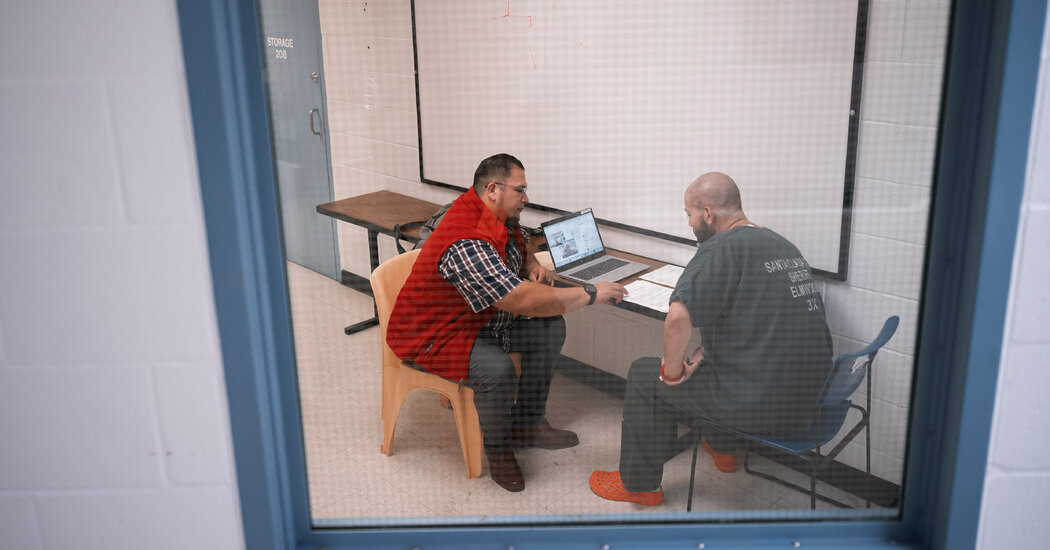
In Santa Clara County, the new process has been underway for 18 months. One afternoon in January, Johnny Granados, an inmate, met with Angel Coronado, a community health worker, at the Elmwood prison to plan his release.
Born in the nearby farming community of Gilroy, Mr. Granados said he became addicted to methamphetamines after his mother died when he was about 18. Before his most recent arrest for a parole violation stemming from petty theft, he had been living in a tent and felt trapped in a cycle of behavior that seemed impossible to break. In prison, He said he got sober and was determined not to relapse. “I’m tired of the tired ones,” he told the clerk.
Mr. Coronado fired up a laptop so they could meet virtually with the case manager at a local nonprofit clinic who would help Mr. Granados after his release.
Together, they double-checked Mr. Granados’ release date, confirmed that his applications for benefits such as food stamps were in progress, and went over his health care needs.
When Mr. Granados was asked for his home address, he paused and then gave his sister’s. Many inmates lack stable housing, but upon release they may be eligible for assistance of up to six months’ rent and a security deposit.
Ideally, the plan would allow Mr. Granados to regain access to the services he needed from the outside and prevent him from falling through the cracks.
Santa Clara Sheriff Bob Jonsen called the Medicaid expansion “fantastic and long overdue.” He said he expects the changes will improve safety in the community and also in prisons. “If you can stabilize people, you will have a safer and more peaceful environment all around,” he said.
Santa Clara had a leg up. In one of the state’s wealthiest and most populous counties, the local government already provided health care in its prisons rather than outsourcing the work.
The county also operates clinics, pharmacies and hospitals in the area, all of which have a common electronic medical records system, making it easier to bill Medi-Cal for eligible services at the prisons.
The changes required greater coordination between courts, prisons and medical services. Now, when the court ordered a person’s release, the medical team was notified to ensure the person had their medication. A public defender could be retained to determine whether release to another county with more family support would be preferable.
“For years, it’s always been sort of three independent structures,” said Michelle de la Calle, who oversaw changes to Santa Clara County’s health care system. “Our approach in Santa Clara County is that there is a person at the center.”
Lots of unknowns
The California rollout is transforming re-entry across the state. All 31 state prisons and 34 county jails and juvenile facilities are participating, with the remainder expected to begin later this year. As of January, more than 50,000 inmates received pre-release services paid for by Medi-Cal, according to the state Department of Health.
Other states aren’t far behind: Medicaid programs in Washington, Montana, New Hampshire, New Mexico and Vermont have begun paying for some re-entry services.
Twelve other states have approved their exemptions. Another eight and the District of Columbia have submitted plans to the federal government, but the Trump administration has yet to approve them. Chris Krepich, a spokesman for CMS, said the agency “carefully reviews demonstration proposals consistent with applicable law and statutory requirements.”
The expansion was complicated by the sweeping changes to Medicaid included in the tax and domestic policy bill that President Trump signed last July. Oregon’s Medicaid program, which had received approval to put a waiver on re-entry services into effect, was withdrawn in October on the grounds that it lacked the bandwidth to address competing priorities forced by federal legislation.
Starting next year, Medicaid participants will have to prove they are working, in school or doing community service to maintain their coverage. That could impact people re-entering the country, said Robin Rudowitz, director of the Medicaid program at health research group KFF.
However, states must exempt people who have recently been released from prison and have certain medical conditions, including substance use disorders. How this works in practice depends on the federal guidelines that have yet to be published. “There are a lot of unknowns,” she said.