













UK extremism expert: As Islamist narratives go mainstream, politicians fear confrontation
LONDON — Britain is losing an “uphill battle” against Islamist extremists, who are deploying antisemitism as a “strategic tool” to undermine Western societies, a leading expert has warned.
In an interview with The Times of Israel, Charlotte Littlewood paints a disturbing picture of the United Kingdom’s failure to tackle Islamism, which, she believes, is strengthening the hand of groups such as the Muslim Brotherhood.
Littlewood, lead researcher for the UK at the Institute for the Study of Global Antisemitism and Policy, also cautions about the rise of “young, hip” Islamists online, who are forging alliances not simply with the far left, but also with the extreme right.
Littlewood’s warning comes against the backdrop of rising antisemitism in the UK in the wake of the bloody October 7, 2023, Hamas invasion of Israel and the ensuing conflict in Gaza. Many of Britain’s cities and university campuses have witnessed fiercely anti-Israel demonstrations, while synagogues and Jewish schools have been forced to ramp up their security.
In February, the Community Security Trust, which monitors antisemitism, reported near-record levels of antisemitic incidents in Britain in 2025. On Yom Kippur, a terrorist attack at the Heaton Park Synagogue in Manchester resulted in the deaths of two worshipers. The attack sparked the highest daily totals for anti-Jewish hate incidents recorded throughout 2025.
Last week, UK ministers followed up on a pledge after the Heaton Park attack to publish their plans to combat extremism. The “social cohesion plan” says the government will make it harder for extremists and “hate preachers” to enter the UK, publish an annual “state of extremism” report, and launch a crackdown on antisemitism on campuses and in public services such as the National Health Service. Regulators will also be given new powers to shut down charities that promote extremism.
Police guard the scene of a terror attack carried out a day earlier at Heaton Park Hebrew Congregation synagogue, in Crumpsall, Manchester, England, October 3, 2025. (AP Photo/Ian Hodgson)
Jewish groups, such as the Jewish Leadership Council and the Board of Deputies of British Jews, gave the plan a cautious welcome — but warned that implementation and “clear leadership” will be key.
Political response
Both Labour and Conservative politicians say action can’t come soon enough. Conservative parliamentarian Paul Goodman warned in a debate in the House of Lords last month that the UK lacks an “overarching policy that seeks to counter Islamist and other extremism in our institutions and civil society.”
While Goodman faulted governments of both parties, he noted that Labour’s response to extremism since taking office in July 2024 has been sluggish. It has left the post of Commissioner for Countering Extremism vacant and its post-election “rapid review” of extremism policy has never been published.
Muslim demonstrators from the pan-Islamic group Hizb ut-Tahrir Britain, which has been designated a terror organization and which advocates for a global caliphate, protest outside the US Embassy in central London, 19 August 2006. (Photo by REBECCA REID / AFP)
Labour MP Damien Egan, chair of a newly established cross-party group on countering extremism, has similarly said that there has been “an underestimation of the scale of the extremism problem and the continuing failure to distinguish the extremist threat from the terrorist threat and the wider harms the former creates.”
In its first report, “Time to Act,” Egan’s parliamentary group cautioned that the UK is “flying blind” in the face of the rising threat.
‘We are just awash with very clever human rights language on the issue, and it’s just [seen as] too toxic to do anything about’
Littlewood shares this analysis. “I think we’ve lost [the] uphill battle at this stage,” she says. “It’s always been a … battle, but now, in the post-October 7 climate, with a new government and a lot of institutional amnesia … and no real counter-extremism agenda, we are just awash with very clever human rights language on the issue, and it’s just [seen as] too toxic to do anything about.”
The government’s new plan, she says, lacks a “renewed counter-extremism strategy” and side-steps the recommendations of an independent review commissioned by the outgoing Conservative administration in 2023. It warned that while the focus of counter-terrorism programs on the growing threat posed by the extreme right was important, “the facts clearly demonstrate that the most lethal threat in the last 20 years has come from Islamism.”
“While Islamist actors are emboldened … [the] appetite to tackle the issue is detrimentally low,” Littlewood says.
A persuasive nihilistic world view
Before becoming an academic specializing in extremism, inter-community conflict and antisemitism, Littlewood worked for the UK’s counterterrorism program, Prevent. She believes that one consequence of the current climate is that the Muslim Brotherhood’s long-running goal of persuading non-Muslims in the West to adopt its worldview is gaining traction.
“We’re now in a very difficult situation where you hear echoes of Islamist narratives; anti-Western, heavily pro-Palestinian, and often quite antisemitic, in the mainstream, which just shows the success of the Muslim Brotherhood strategy,” she says.
Pro-Palestinian, anti-Israel protesters take part in a demonstration on Al Quds Day, in London, April 5, 2024 (AP Photo/Kin Cheung)
Littlewood believes a “real concern” is that Islamists are not only targeting the Jewish community because of Israel, but also as a way of forging allegiances with both the far left and the far right.
“I think that antisemitism has become their main strategic tool for upending the liberal Western order,” she says. “It’s very clever, and they’re using it to create collaboration and to get people engaged in their narrative and their way of viewing the world, and it’s being very successful.”
‘Antisemitism has become their main strategic tool for upending the liberal Western order’
Muslim Brotherhood strategy documents from the 1990s placed the Israel-Palestinian conflict front and center of the effort to make their message appealing to wider Western audiences.
If the horseshoe fits…
In the UK, the controversy sparked by the 2003 Iraq war hastened the building of alliances between Islamist groups and far-left politicians and activists.
“I think that [the far left and Islamists] just find common ground quite naturally, but if you look back at the 1990s Muslim Brotherhood’s strategic documents, they talk about making these alliances. It’s strategic, and it’s planned,” Littlewood says.
She also identifies the emergence of non-violent, “soft Islamism” propagated by online “young, hip Islamists.”
“They’re young, popular, with big followings [on social media], very clever in how they articulate themselves [so as] not to come across sounding like al -Qaeda or ISIS,” Littlewood says. However, she warns, the Islamist ideals they are professing “could lead someone along a similar path.”
Islamist influencer Mohammed Hijab, right, appears with antisemitic streamer Sneako to discuss ‘Jewish supremacy’ in this screenshot from March 1, 2026. (YouTube)
Littlewood believes that evidence is also now emerging of Islamists engaging with the far right.
“It’s knowing how to speak to people and how to build on people’s current feelings and grievances and what they care about,” she says. “Islamists know very well how to do that with the left, and they’re just starting to do that with the right.”
She cites the way in which 5 Pillars, a hardline Islamist website, has featured interviews on its podcast with British far-right figures including Nick Griffin, the former leader of the British National Party; Mark Collett, leader of the neo-Nazi Patriotic Alliance; and Jayda Fransen, the ex-leader of Britain First.
While Collett and Griffin are strongly anti-Israel, Littlewood warns that other far-right figures who profess to be more sympathetic to the Jewish state, such as Tommy Robinson, cannot be trusted.
‘The far right has the capacity to be violent and is getting more extreme in its rhetoric’
“He has always been very divisive and dangerous,” she says. “I think he flip-flops according to what he wants to achieve politically at that time, and he jumps into any mess he can to stoke up as much tension as possible.”
Littlewood says that Britain needs to keep a “firm eye” on both Islamists and far-right extremists.
“The far right has the capacity to be violent and is getting more extreme in its rhetoric,” she says. “We absolutely shouldn’t take our eyes off that.”
Extremist outlet 5 Pillars editor Dilly Hussain interviews antisemite and Holocaust denier Nick Griffin, the former head of the fascist British National Party, in his podcast Blood Brothers, November 29, 2023. (Screenshot)
But Littlewood believes that politicians and public servants have a “greater ease and comfort” in dealing with the far right than they do with Islamists.
Littlewood says that both the current Labour government and its Conservative predecessor shied away from tackling Islamist extremists.
Littlewood’s experience in Prevent — she worked in the northeast London borough of Waltham Forest — causes her to believe that official reticence in tackling Islamism sometimes stems from political calculation, especially in areas where there is a large Muslim vote.
‘Rightly or wrongly, the assumption is that if you get involved with tackling Islamism, you’re going to lose that voting base’
“Rightly or wrongly, the assumption is that if you get involved with tackling Islamism, you’re going to lose that voting base,” she says. “That assumption may not necessarily be correct, but there are a few loud enough voices [who] say that they have control of these votes, and that they are very influential, and that … can really intimidate government into stepping away from these issues.”
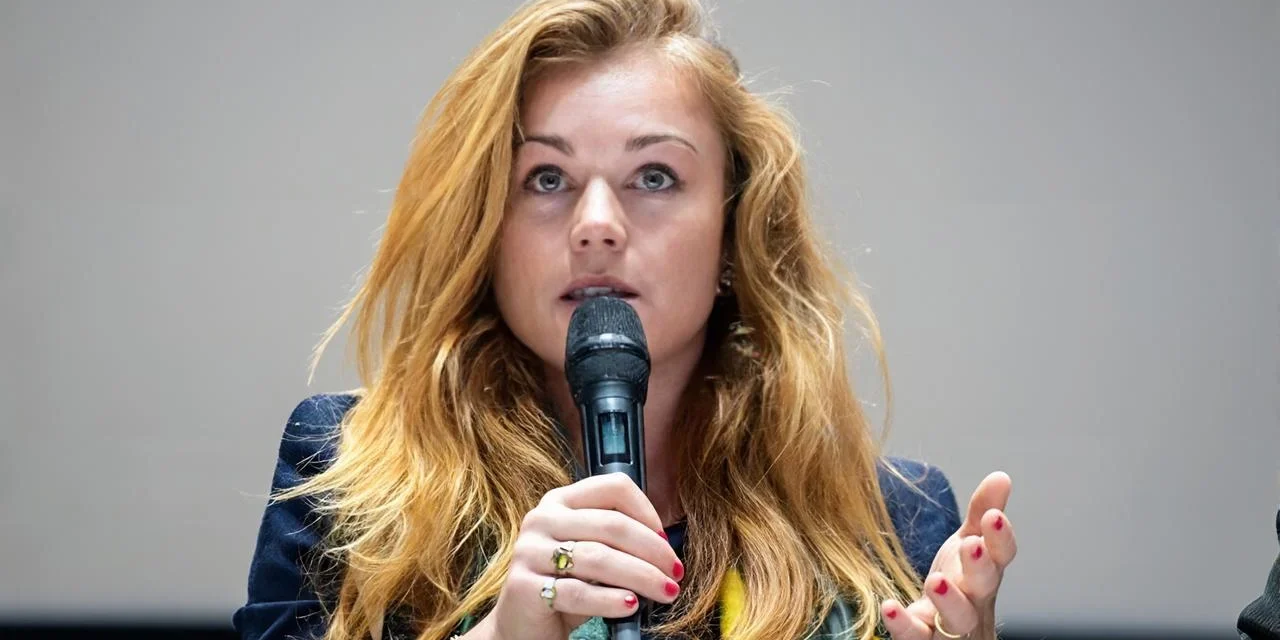
Charlotte Littlewood speaks at a London Center for the Study of Contemporary Antisemitism event in this undated photo. (Lakruwan Rajapaksha/ London Center for the Study of Contemporary Antisemitism)
Jihadist or human rights warrior?
Littlewood also believes that “institutional amnesia” and a lack of expertise also play a part in the rise of extremism in the UK.
“You have to know quite a lot about the Muslim Brotherhood, its history and aims and [that its] ultimate intention is to bring about a global caliphate,” she says by way of example. “You have to know that inside out … to recognize that as a threat and not see [Islamist rhetoric] as just someone concerned about human rights in another country.”
She recognizes that the challenge has evolved and become more complex over the past decade. The al-Qaeda-inspired jihadi threat was “easier to identify and monitor” because it more often involved networks linked to a number of key radicalizers and extremist groups. But ISIS, the advent of online radicalization and the emergence of the “lone wolf” attacker have made the threat more diffuse and difficult to track.
Nonetheless, there is also, Littlewood says, a “psychological” fear of being labeled racist or Islamophobic, which makes public officials warier about reporting or tackling Islamist threats than those posed by the far right. Teachers, for instance, find it easier to identify and report far-right threats to counter-terrorism programs.
Dr. Imran Wahid addresses the National Conference of the pan-Islamic group Hizb ut-Tahrir, since designated a terror organization, at The Quaker House in London, September 4, 2005. (GEOFF CADDICK / AFP)
“They’re very upset by it, and they don’t have any moral quandary in calling it in, but they will stumble and second-guess themselves on something to do with Islamism,” Littlewood says. The result of these “skewed” referrals, she says, is a potentially inaccurate picture of the nature of the domestic threat.
Littlewood believes there needs to be a new focus on “really understanding the ideological nature of Islamist extremism,” together with a revitalized counter-extremism initiative. More and better-skilled counter-terrorism and counter-extremism experts need to be deployed on the ground and their independence ensured to isolate them from local political considerations and interests.
But, most importantly, she says those who oppose both Islamists and extremists on the far left and far right need to recognize they’re involved in a battle over narratives.
“We need to build a stronger narrative with a cohesive set of liberal, centrist values, which build confidence in who we are,” she says. “Britain is not going to get less diverse, we are going to get more diverse, but [for so long as] we don’t stand for any clear values, and have not got to grips with who we are, our values can be dictated to us, and that’s what I think is happening.”
