












Experts say USAID’s closure has made containing the virus more difficult
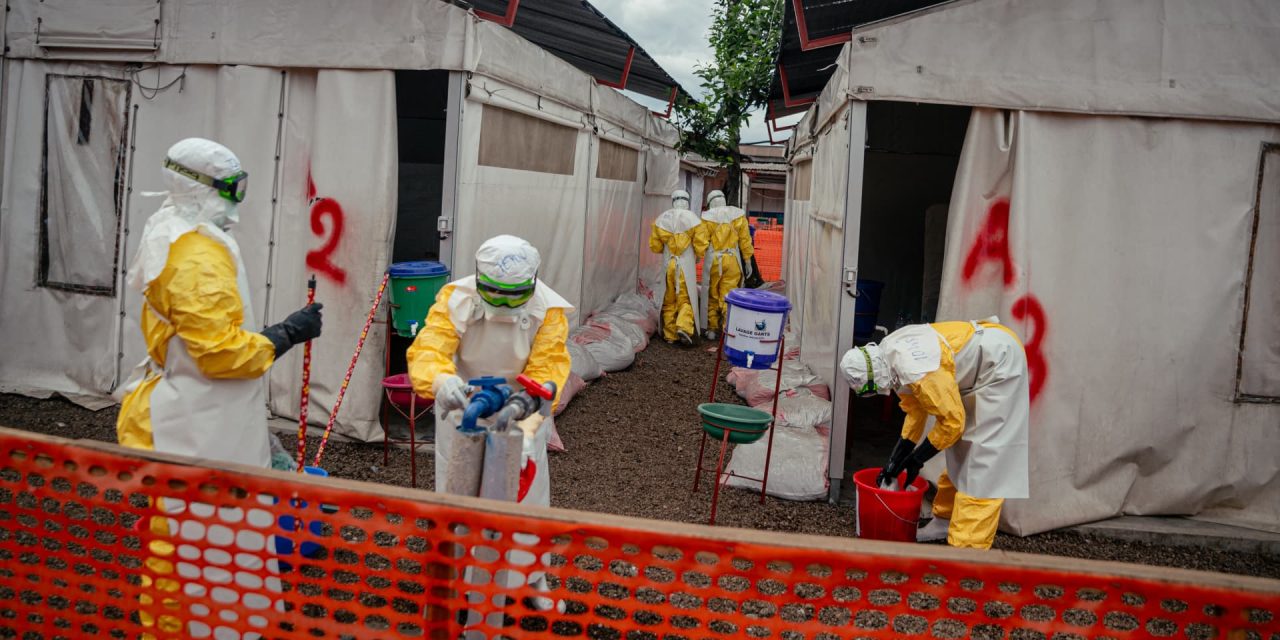
Médecins Sans Frontières health workers wearing personal protective equipment move through the isolated red zone on June 2, 2026, to monitor patients, provide medical care and ensure sanitation at the Ebola treatment center in Munigi, Congo.
Jospin Mwisha AFP | Getty Images
An outbreak of the deadly Ebola virus in Central Africa has been exacerbated by cuts in U.S. and Western foreign aid, experts say, a year after Washington slashed its international aid operations.
In May, authorities in the Democratic Republic of Congo and Uganda reported outbreaks after laboratory tests detected the spread of the Bundibugyo virus, which causes a type of Ebola disease. Transmitted through contact with infected bodily fluids, wild animals and contaminated objects or meat, Ebola is a rare but serious disease with a fatality rate of about 50%.
The current outbreak is the 17th that the Democratic Republic of Congo has suffered. According to the U.S. Centers for Disease Control and Prevention, it is the third-largest outbreak on record, with more than 1,400 confirmed cases so far. There are currently no known cases reported in the United States, but one case has been confirmed in France. The latest data from the CDC shows there have been 440 confirmed deaths from the virus.
Near the start of the outbreak, the International Rescue Committee – a global non-governmental organization focused on humanitarian assistance, relief and development – warned that without urgent intervention, the current outbreak could become the deadliest on record.
“The warning signs are flashing red,” Bob Kitchen, vice president of emergencies at the IRC, said in a statement, before noting that the Democratic Republic of Congo faces the current outbreak “more fragile and less prepared” than it was during the 2018-2020 outbreak, which killed more than 2,000 people.
“Intensified conflict and cuts in global aid have reduced defenses at exactly the wrong moment,” Kitchen said. “Risks are growing and resources are shrinking; this is the brutal reckoning global aid faces today.”
The U.S. Agency for International Development officially closed last July, with most of its programs eliminated and a small remainder transferred to the U.S. State Department. The move drew criticism from former Presidents Barack Obama and George W. Bush, as well as billionaire philanthropist Bill Gates.
USAID’s demise was part of cuts to the Department of Government Efficiency (DOGE), a temporary agency created by President Donald Trump shortly after his return to the White House. Billionaire entrepreneur Elon Musk initially oversaw DOGE’s operations and recently defended decisions to cut USAID after claims it contributed to the deaths of children.
DOGE was officially closed on July 4, 2026.
President Donald Trump holds a news conference with Elon Musk in the Oval Office of the White House in Washington on Friday, May 30, 2025, to mark the end of the Tesla CEO’s term as special government employee with oversight of the U.S. DOGE service.
Tom Brenner | The Washington Post | Getty Images
However, the recent cuts to foreign aid programs don’t just apply to the United States. Last year, the charity Oxfam found that the G7 countries, which together account for about 75% of total official development assistance, will cut their aid spending by 28% in 2026 compared to 2024 levels.
French foreign aid is expected to fall by about a third since 2023, according to a recently published analysis by researchers at the Barcelona Institute for Global Health. German development aid will fall by more than 36%, while British development aid will fall by 45% compared to recent highs.
Virologist Angela Rasmussen is scientific chair of the activist group Save America Movement – a non-partisan organization whose goal is to defend “American values,” including the Constitution, public health, the economy and the United States’ position as a global leader.
She told CNBC in an email that aid cuts have “demonstrably worsened” the Ebola crisis in Central Africa. Cuts to critical infrastructure previously funded by USAID have led to increased violence and reduced capacity in the region where the outbreak is occurring, she said.
In early 2025, fighting broke out between Congolese authorities and groups led by the paramilitary rebel group M23. The climax was the capture of Goma, a key city on the border with Rwanda, which in turn increased nationwide political violence. According to the Council on Foreign Relations, Islamic State-linked groups have also carried out attacks in eastern Democratic Republic of Congo, with rocket attacks and fighting between M23, Rwandan troops, Congolese forces and other militia groups remaining common in the region.
According to CfR, the situation in the Democratic Republic of Congo is one of the largest and deadliest humanitarian crises in the world. One million Congolese are seeking refuge abroad and 21 million are still in the country in need of urgent assistance, including medical assistance and supplies.
A poster with Ebola emergency contact numbers is attached to a tent at the Busunga border crossing between Uganda and the Democratic Republic of Congo in Bundibugyo on May 18, 2026.
Badru Katumba | AFP | Getty Images
“The ongoing civil war and lack of well-developed transportation networks have led to restricted mobility, and these funding cuts have significantly weakened trust in humanitarian and medical workers, making it difficult and in some cases dangerous to trace contacts or treat Ebola patients,” Rasmussen told CNBC.
“Shipments cannot get through and USAID-funded medical supplies (basic supplies such as gloves, PPE and body bags) are not reaching the most affected areas of Ituri Province.”
Rasmussen added that the loss of USAID-funded cold chain infrastructure caused swab samples to decompose during transport to biomedical testing facilities, contributing to delays in detecting the virus.
“Confirmation of cases is still lagging significantly as the loss of USAID funding has left the health system short of supplies, equipment, facilities and staff to operate,” she said.
Jade Le, an infectious disease specialist and head of infectious diseases at Access TeleCare, also told CNBC that foreign aid cuts have made containing the Ebola outbreak “absolutely” more difficult. She said USAID has traditionally been heavily involved in building health infrastructure in countries like the Democratic Republic of Congo, from training health workers to recognize signs and symptoms of diseases such as Ebola, to providing testing kits and personal protective equipment, to helping transport samples to laboratories equipped to test and identify the Ebola virus.
“With the dissolution of USAID, funding cuts and withdrawal from the WHO, staff reductions at the CDC, and reduced health assistance to the Democratic Republic of Congo, the Trump administration has certainly contributed to the delay in detection and lack of control of this current outbreak,” she said in an email.
CNBC contacted the U.S. government for comment on the impact of foreign aid cuts.
“Historically, the U.S. has been involved early in outbreaks like this. Epidemic Intelligence Service officials have been deployed to investigate outbreaks before they spread rapidly, to quickly identify the cause, appropriately isolate patients, and conduct contact tracing to ensure control of outbreaks,” Le said.
“This time, unfortunately, U.S. health and medical experts were mobilized much later than in previous outbreaks, and the release of U.S. resources to assist in controlling this outbreak will be less effective than if there had been sustained USAID programming.”
Choose CNBC as your preferred source on Google and never miss a moment from the most trusted name in business news.