












Many World Cup fans would rather skip the drinking breaks
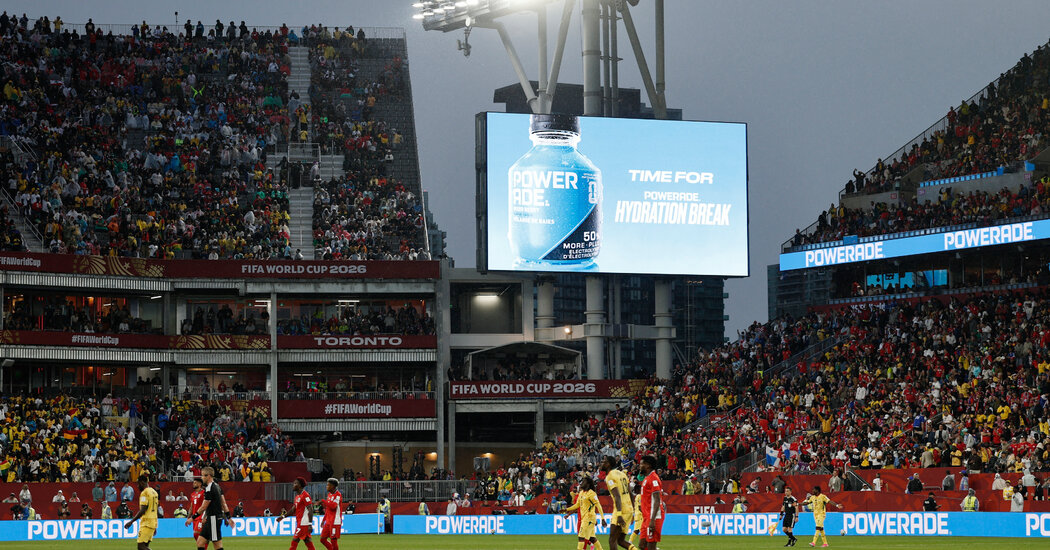
The “drinking breaks” added to World Cup matches have not met with widespread approval from players and fans, not least because some television networks have used them to display additional advertising.
June is hot across much of North America, and in some places it is very hot. So it makes sense that players at the World Cup, currently taking place in the United States, Mexico and Canada, take short breaks to drink in the middle of each half.
But the breaks were not universally popular. Aside from being upset about the extra advertising, fans are also upset that the flow of the game is being interrupted, and some believe that the team they support might somehow lose momentum due to the interruption.
Football is traditionally a free-flowing game. Each half is scheduled to last 45 minutes and there are only short stops, for example after a goal or when the ball goes out of bounds.
But concerns about players’ health have led to water supplies being cut off in recent years. In particular, at last summer’s Club World Cup in the United States, referees allowed water breaks at their own discretion. In December, FIFA, the world football governing body, decided to make breaks more regular and consistent.
At this World Cup, the referee blows his whistle halfway through each half and the players head to the sidelines for a three-minute drinking break.
For consistency, there are no exceptions, even in cooler weather or rain. The breaks are even taken in air-conditioned dome stadiums.
Some fans of the games were apparently hoping for more non-stop action and booed the breaks. Others have complained on social media.
Fans from outside the United States note that the breaks have essentially turned football into a game with four quarters rather than two halves – more like American football, they suggest darkly.
Not all players and coaches have accepted the innovation either. “I don’t like it,” Mauricio Pochettino, the U.S. coach, told reporters. “I only like it when the conditions are extreme, but when the conditions are good it’s unnecessary.”
Dutch star Virgil van Dijk was among the players who said he didn’t like the extra breaks.
Some television networks around the world have made the breaks even more annoying for fans by using the breaks to insert commercials, something that is normally banned except at halftime.
Fox, which owns the English-language rights to the Cup in the United States, is running ads, but Telemundo, the Spanish-language broadcaster, is not. Fox and Telemundo did not immediately respond to requests for comment on their decisions.
Some teams may have benefited from the breaks. Brazil coach Carlo Ancelotti admitted he made tactical adjustments in the first half that helped his team equalize after their 1-0 loss to Morocco on Saturday.
Another concern for some is the unquantifiable notion of dynamism.
Sometimes goals were scored shortly after a drinking break (as they can of course be scored at any time). And when that’s the case, the other team’s fans have complained that their “momentum” has somehow been broken. (It is of course impossible to say whether the goal would have been scored without a break.)
In Wednesday’s England-Croatia game at a domed stadium near Dallas, Croatia equalized at 1-1 not long after the first-half drinking break, prompting rumors that the break had weakened England’s mojo.
Those claims became much quieter after England won 4-2.