














As the Ebola outbreak spreads, scientists are trying to test treatments
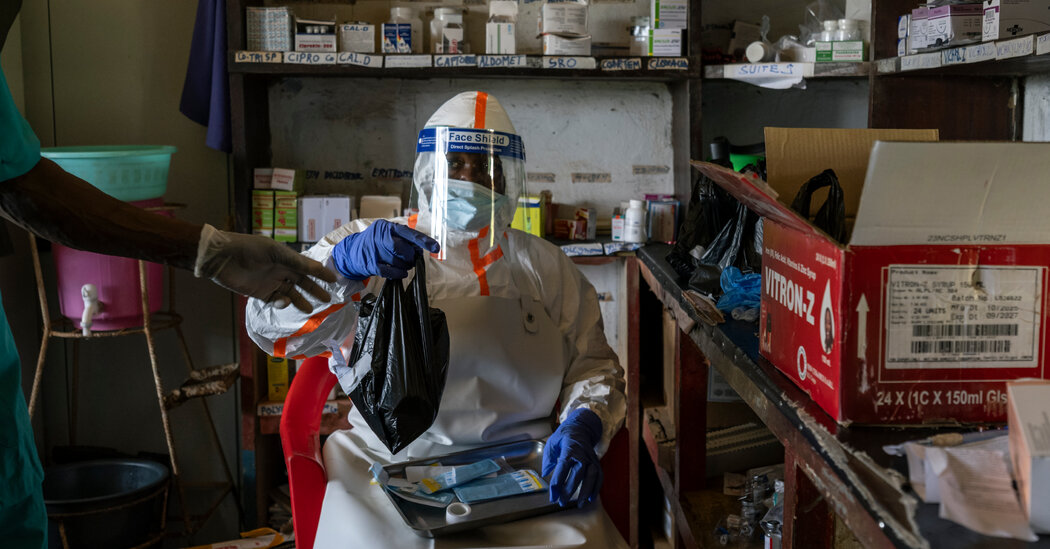
At a hastily constructed Ebola treatment center in Rwampara, Democratic Republic of Congo, Drs. Papys Lame and his colleagues transfuse patients who arrive with bouts of diarrhea and vomiting, those bleeding uncontrollably from the nose and mouth, and provide oxygen to patients in respiratory distress. They monitor patients’ hearts and blood pressure and treat their severe pain.
This is a significant improvement compared to the outbreaks Dr. Lame, the Ebola response coordinator in Congo for the Alliance for International Medical Action, worked five years ago. “Today we have more opportunities and more people survive,” he said.
But they’re still missing something crucial: a treatment that specifically targets the Bundibugyo virus, the species that caused the current outbreak in East Africa. So far, at least 695 people have been infected and 138 have died. Scientists are intensively searching for drugs that could work.
Why are there no treatment options for Bundibugyo virus?
Over the past 50 years, most Ebola outbreaks have been caused by a different type of virus called the Ebola virus. Based on clinical trials, the World Health Organization recommends two drugs to treat the Ebola virus.
But just because scientists know a drug works against one virus doesn’t mean it works against the other. Their evolutionary differences are simply too great.
After the Bundibugyo virus emerged in 2007, scientists conducted preliminary experiments on cells and animals to see if drugs could stop it. Some of these studies produced promising results. However, scientists did not pursue the research further because there had only been two small outbreaks of the Bundibugyo virus before. With limited resources to conduct the expensive research, they had to pick their battles.
“If you were to bet, you wouldn’t have bet that Bundibugyo would do anything big,” said Thomas Geisbert, a virologist at the University of Texas Medical Branch at Galveston. “And of course we’re all wrong now.”
Now scientists are rushing to find drugs to test against the Bundibugyo virus in clinical trials. The WHO has compiled a list of candidates for immediate testing. Scientists are also looking for other compounds that might be worth testing.
What would a drug have to do to work?
One type of drug that works against viruses is called a monoclonal antibody. This molecule binds to the surface of a virus and prevents it from entering cells.
Other drugs, called antiviral drugs, stop viruses from replicating once they have entered cells. Some grab viral proteins and cause them to shut down. The deactivated proteins can no longer perform important tasks such as producing new virus genes.
A monoclonal antibody called MBP-134 has proven effective in stopping Bundibugyo infections in monkeys, and early clinical trials on the Ebola virus have also shown it to be safe for humans.
In some cases, doctors are already using MBP-134 to treat Bundibugyo infections. An American doctor, Dr. Peter Stafford, received it after he was infected in Congo and was flown to Europe for treatment last month. He also received remdesivir, an antiviral drug that has been used in the past for other illnesses, including Covid. It has shown promise in early studies of the Bundibugyo virus.
Dr. Stafford was released from the Berlin Charité on June 6th. Whether MBP-134 or remdesivir helped save his life cannot be said with certainty. The only way to gain this kind of knowledge is through carefully designed clinical trials that compare people receiving experimental drugs with those receiving only supportive care.
Clinical trials could begin soon.
To prioritize which drugs to test in trials, the WHO brought together experts to review preliminary studies. On May 28, they recommended moving MBP-134 and remdesivir into clinical trials along with another monoclonal antibody, maftivimab, and another antiviral, obeldesivir.
A typical clinical trial can take many months or even years. It takes time to get regulatory approval, organize logistics and find enough patients for treatment. Many past Ebola outbreaks ended before clinical trials could even begin.
The Bundibugyo outbreak could be different, Dr. Amanda Rojek, associate professor of health emergencies at Oxford University and Ebola response veteran. She and other researchers have developed a new type of clinical trial that allows a single drug to be tested in multiple outbreaks caused by different viruses.
Dr. Rojek and her colleagues began testing remdesivir in Rwanda in 2024 during the outbreak of Marburg, another type of virus that causes a deadly disease similar to Ebola. Dr. Rojek plans to combine these results with a new study testing remdesivir against the Bundibugyo virus.
While the study design could accelerate results, the current outbreak presents a number of challenges, she warned. It is taking place in an active conflict area and treatment centers are just being set up. And there is limited infrastructure to support clinical trials.
What treatments are being tested?
Given the magnitude of the treatment need, there are frustratingly few good candidates for scientists to test.
“There are only a limited number of candidates available for clinical trials, which means that in the event of failure there are no ready alternatives in the pipeline,” said Carmen Pérez Casas, head of pandemic preparedness at global health agency Unitaid, which is trying to raise funds for early clinical testing of possible therapeutics.
Dr. Rojek’s study will test two of the treatments that are on the WHO’s priority list. Some patients receive MBP-134, others receive MBP-134 plus remdesivir. “We think there may be a combination effect between some of these agents,” she said.
The study is in the final stages of regulatory approval, she said.
“I’m pretty optimistic that remdesivir could work,” said Dr. Salim Abdool Karim, who is in Congo and leads the Africa Centers for Disease Control and Prevention expert group on the outbreak. “The effectiveness will be seen quite quickly because we have the patients there in the hospital. And if remdesivir does work, it is a fairly cheap drug and generics are widely available.”
Are there medications that can prevent people from getting sick in the first place?
Possibly.
Public health workers in Congo and Uganda are tracking down people who have had contact with patients and may be infected. For now, the contact persons have to wait in isolation to see whether they develop symptoms.
Researchers hope to test an antiviral that could reduce the risk of contacts contracting Ebola disease – a strategy known as post-exposure prophylaxis.
The study will test a 10-day treatment with obeldesivir. The drug is essentially a low-cost, oral form of remdesivir.
“This is the potential tipping point,” said Dr. Armand Sprecher, an epidemiologist and emergency doctor with Doctors Without Borders who has worked on half a dozen Ebola outbreaks. “For someone who incubates a disease, you could effectively cure them before they get sick. And it also means that they are not in the community that is shedding the virus.”
Promising evidence for the effectiveness of obeldesivir emerged from a study conducted last year by Dr. Geisbert and his colleagues published a study. They administered obeldesivir to monkeys just 24 hours after infection with the Ebola virus – long before they would normally show symptoms.
“They were completely protected,” said Dr. Geisbert. “I mean, they didn’t even get sick.”
They also tested the drug against another type of virus that causes Ebola disease, called Sudan virus, and against Marburg. In all three cases, obeldesivir protected the animals.
But before the current outbreak, scientists had not yet tested it on monkeys infected with the Bundibugyo virus.
For pre-exposure prophylaxis to work, a healthcare system must effectively trace contacts. An effective drug would give those leading the outbreak response something to offer to people, an incentive for sick people to go to isolation wards if they knew that the family members they were caring for could get the protective pills.
If one of these drugs works, will East Africans get it?
The family members of Dr. Stafford, the American doctor who was being treated for the virus, was given MBP-134 in Berlin as post-exposure prophylaxis. None developed Ebola disease. As they left the hospital, Dr. Stafford expressed his gratitude, but added that he hoped all patients in Congo could receive the same level of care as he and his family.
Questions of access have plagued treatments tested in previous Ebola outbreaks. Dr. Rojek called post-test access a critical issue and said it is “currently being worked on” for the therapeutics that could be tested in this outbreak.
During an Ebola outbreak in Congo in 2019, a study funded largely by the U.S. National Institutes of Health tested four monoclonal antibody treatments. Two of the drugs reduced patient deaths by up to 50 percent. One of them was developed from the blood of a Congolese Ebola survivor.
But despite the public funding and local origin of the treatments, there was no guarantee that the promising drugs would be delivered to Congo. Two companies, Regeneron and Ridgeback Biotherapeutics, ultimately owned the intellectual property. Neither drug has yet been approved in any of the countries experiencing Ebola outbreaks.
Ridegeback says it provided one of the drugs, ansuvimab, free of charge under a special access protocol during four Ebola outbreaks in the Democratic Republic of Congo, but would not say how many patients had received it. Regeneron has a similar regulation for its drug; The company says it has donated 500 doses to the WHO. However, the majority of supplies of both drugs are located in the United States National Security Depot.
