












Citing Israel’s ‘international crimes,’ NYC student government trying to defund Hillel
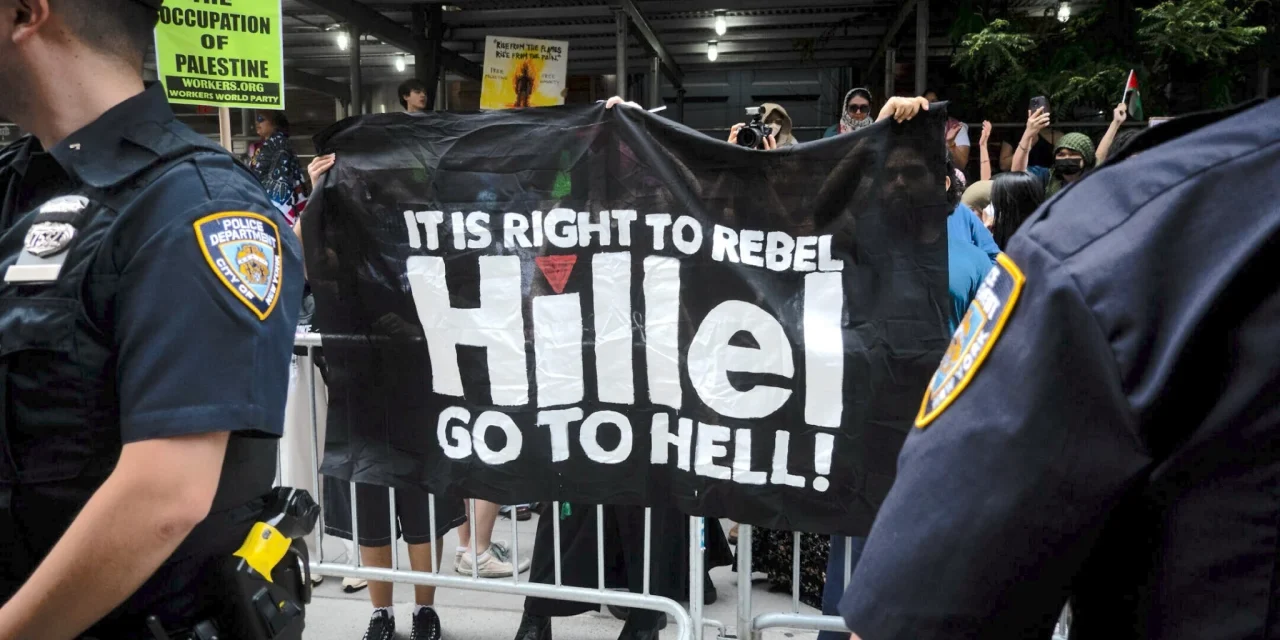
NEW YORK — The student senate at Manhattan’s New School announced its “landmark decision” to defund its Jewish students’ club earlier this month. Ironically, the decision came down shortly before Shabbat.
“Hillel at the New School is ineligible for funding from or collaboration with the [student senate] in any capacity,” the announcement said, accusing the Jewish club of “extensive ties to violations of international law.”
The vote — rejected by the university administration — marked the first time a US university’s student government had cut off its Hillel, long seen as the main address for Jewish life on most American campuses.
The announcement surprised the campus Hillel director, but the student senate had been quietly working toward the move for months, basing its decision on an anti-Israel base built in forums from the United Nations and human rights groups to medical journals and City Hall.
The process illustrated how a global network can come to bear on individual Jews, sparking fear in students and setting a precedent that could be used against Jewish clubs on other campuses.
Get The Times of Israel’s Daily Edition
by email and never miss our top stories
By signing up, you agree to the terms
“I saw all of my classmates posting, reposting and cheering,” an Israeli New School student said of the announcement against Hillel. “I thought, I’m not going to have a Jewish club anymore, which for me, is really home away from home and they supported me.”
“That’s the only place I felt safe as a Jewish student on campus,” she said.
The New School in New York City, May 6, 2026. (Luke Tress/Times of Israel)
Building a case
Hillel is the leading international Jewish student organization, with around 850 chapters. The New School’s chapter is part of a network centered at the nearby Baruch College that serves students at nine colleges. Following the war in Gaza, launched by the Hamas onslaught on southern Israel on October 7, 2023, anti-Zionist activists have targeted that network due to its ties to Israel.
The New School is a private university in Manhattan, known for its progressive politics, with around 9,000 students. The student senate in 2024 attempted to block funding to all student groups, demanding “divestment from industries implicated in military and police violence in Gaza and the West Bank,” but the university’s administration circumvented that vote. Weeks later, the senate attempted to cut off Hillel, but was blocked by the administration, a Jewish student said.
Those campaigns unnerved Jewish students, but failed to produce any concrete effects, such as banning Hillel or stripping its funds.
In January, the student senate posted a declaration including a commitment to “international law.” A week later, the student senate established a committee tasked with ensuring that student organizations were in “compliance with international law.”
Masked protesters wearing Hamas headbands protest against Baruch College’s Hillel student group, in New York City, June 5, 2024. (Luke Tress/JTA)
In April, the committee put Hillel under review, saying the club “potentially collaborates with foreign militaries to violate international law.”
That months-long process ended on Friday with the statement from the senate and a 38-page report, condemning Hillel for activities such as preparing a barbecue for IDF soldiers and packing food for troops. The report reused some of the evidence and language from the failed 2024 resolution against Hillel.
“To continue to fund Hillel at the New School would mean that your student fees would be used to support violations of international law,” the report said, implicating the student body in Hillel’s alleged crimes. “Our shared values require us to enforce our policies until Hillel agrees to affirm and abide by international law.”
To reinstate funding, Hillel must sever all ties with and renounce Hillel International, and end participation in Israel programs, the student senate said.
Global foundations for a purge
The students accused Hillel of several crimes, including complicity in the “extrajudicial execution” of Iranian supreme leader Ali Khamenei and “illegal territorial seizure” in visits to the Golan Heights.
The core of the students’ argument was that Hillel participated in war crimes, apartheid and genocide by volunteering on IDF bases.
The report cited organizations like UN bodies, Amnesty International and international courts to make its case — groups that have had an outsize focus on Israel that critics say is biased and discriminatory.
Anti-Israel signs are seen posted on windows as The New School faculty set up a pro-Palestinian encampment on the university’s campus May 08, 2024 in New York City (Michael M. Santiago/Getty Images/AFP)
The report also claimed authority from New York City Mayor Zohran Mamdani’s declaration that the city “stands up for international law,” stating that the senate was “delivering on that commitment.” Mamdani made the statement while vowing to arrest Prime Minister Benjamin Netanyahu on an International Criminal Court warrant, despite lacking legal authority to make such an arrest.
The students’ report relied on other anti-Israel sources, claiming up to 680,000 Palestinians killed in Gaza, citing speculative claims online and in a medical journal that vastly inflate Hamas figures.
On top of those foundations, the students erected their argument for cutting off Hillel.
“‘Hillel at The New School’ has materially supported a foreign army engaged in gross human rights abuses, including war crimes, apartheid, and genocide,” the report said.
The senate added that its determination was “not based on political opinion, religious identity, ideological disagreement, or disagreement over free speech.”
‘Totally made up’
Eugene Kontorovich, an international law expert and professor at George Mason University’s Scalia Law School, said the argument was baseless.
“There is no international law prohibition on volunteering at IDF bases or any army bases. This is totally made up,” Kontorovich said. “Moreover, the US government, which determines US positions on international law matters, has never said anything like this.”
Student activists and their allies protest in front of the New School in support of an encampment for pro-Palestinian, anti-Israel protesters on April 21, 2024 in New York City. (Stephanie Keith/Getty Images/AFP)
No international court has convicted Israelis of war crimes. The International Criminal Court and the International Court of Justice are investigating alleged Israeli crimes, but have not issued final rulings.
The student senate report, however, treats the investigations as criminal convictions. But even if soldiers at the bases where students volunteered were convicted of war crimes, the New School students would not be criminally liable. That would require proof that individual students knowingly and purposefully helped facilitate a specific crime — a far cry from hosting a barbecue or packing foodstuffs. (The student senate did not respond to requests for comment.)
Resolution underlines years of hostility
Students who spoke with The Times of Israel, requesting anonymity due to fears of retaliation, said the resolution came after years of hostility.
The Israeli said that when she presents in class, other students exit the room, and classmates who work with her are harassed. She is derided as a “Nazi” and she says her friends have stopped wearing their Star of David pendants.
A protester flashes an inverted triangle, a symbol associated with Hamas, at Jewish counter-protesters, during a rally against the Hillel chapter at Baruch College, in New York City, June 5, 2024. (Luke Tress/Times of Israel)
“It’s a very liberal school where if you are racist to Black people, LGBTQ, Asians, you will be canceled, but to be racist to Jews, it’s okay,” she said. “I could never imagine before moving here that I would be part of such an antisemitic institute, and that’s something that still exists.”
In Israel, she had been a leftist non-Zionist and participated in Israeli-Palestinian coexistence programs.
“Even if they know that, I’m Israeli and I was in the IDF — that’s enough. I’m a ‘Nazi,’” she said. “They’re doing what they are saying they are against. They are racist and not looking at people as human beings, which is what they say they are fighting for.”
Now months into her studies, her anti-Zionist views had changed. While she still supports the Palestinians, she realized, “Thank God I have a country to escape to.”
“It made me be Zionist,” she said.
Another member of Hillel added that the senate’s report indicated the student government had been monitoring Hillel for years.
He attributed the hostile atmosphere to a relatively small but vocal cadre that is “able to easily influence people who might not know what’s going on.”
“You just need a few crazy people to indoctrinate an entire school,” he said.
Fears for the future
A day after the resolution passed, Hillel International said it was communicating with the New School, and a spokesperson for the university said the student senate did not have the authority to cut off Hillel and that the Jewish club remained “in good standing.”
Police stand between protesters targeting the Hillel at Baruch College and counter-demonstrators, in New York City, June 5, 2024. (Luke Tress/Times of Israel)
University President Joel Towers sent a message to the campus community, saying the senate was “distorting a qualified student organization and characterizing it as something it is not,” and was “using its platform to target fellow students in a misguided attempt to hold those students responsible for the acts of governments.”
Towers told The Times of Israel in a statement that the administration was meeting with Hillel student leaders “to ensure Jewish students feel supported.”
“Every New School student, regardless of identity, background, or affiliation, is welcome, valued and respected as a member of our university community,” Towers said. “They are entitled to full participation in campus life without fear of bias, discrimination, intimidation, or harassment. That’s why the University Student Senate’s action was unacceptable.”
Towers added that the student senate’s vote was “moot, having no actual effect on Hillel’s status,” and that a formal review was underway.
The Hillel members supported the administration’s response, but sought more action, including consequences for the students involved or structural changes at the school. The Israeli student said there was a “huge gap” between the administration and the positions of faculty and students.
Illustrative: An anti-Zionist protester in New York City, May 5, 2026. (Luke Tress/Times of Israel)
The non-Israeli Hillel member feared the deteriorating atmosphere could foment violence. Recent polls have shown that younger, more leftist, and better-educated Americans are more open to political violence.
“I’m very worried for the students who are going to continue after me. I don’t know how they’re going to handle this,” he said.
“It’s everyone. It’s so extreme that it’s got to the not extreme [people],” the Israeli student said. “The students and the teachers, or the faculty, are getting more extreme and it’s going really to a bad direction.”
Ilya Bratman, the head of the campus Hillel, said the resolution was “a symptom of a much bigger movement.” He and other Jewish leaders fear student governments elsewhere will prosecute their Hillels using the same blueprint.
“All these entities are going after Jewish life on campus. New School, it’s just the beginning. It’s a precedent that’s set for a bunch of campuses,” Bratman said. “We will see this as an epidemic of hate and exclusion.”
Makings of a movement?
The New School resolution has already energized a movement to “Drop Hillel,” including at New York University, and some New School professors have backed the student senate. An open letter supporting the resolution against Hillel has garnered more than 330 signatures, including from faculty at the New School and other universities.
A student, left, meets with a social worker at the Hillel at Baruch College. (UJA via JTA)
After the administration rejected the senate’s resolution, the students doubled down, saying the senate “will continue to sanction Hillel.”
In a virtual meeting on Friday, Hillel student leader Michael Valdes told student senate representatives, “Political disagreement cannot become the justification for excluding a student club from campus life,” and that the vote sent a chilling message to other student groups.
“When leadership contributes to the exclusion of a specific community from campus life, we have to seriously ask what message that sends,” he said.
Senate members on the call told Valdez there would be an appeals process, and that the vote was not based on religious identity or political identity, but part of a “universal process.”
The senate did not indicate any change in direction.
“This is a matter of international law and the violations that we found are extremely serious,” a senate leader told Valdes.