

















UnitedHealth Group (UNH) Q4 2025 results
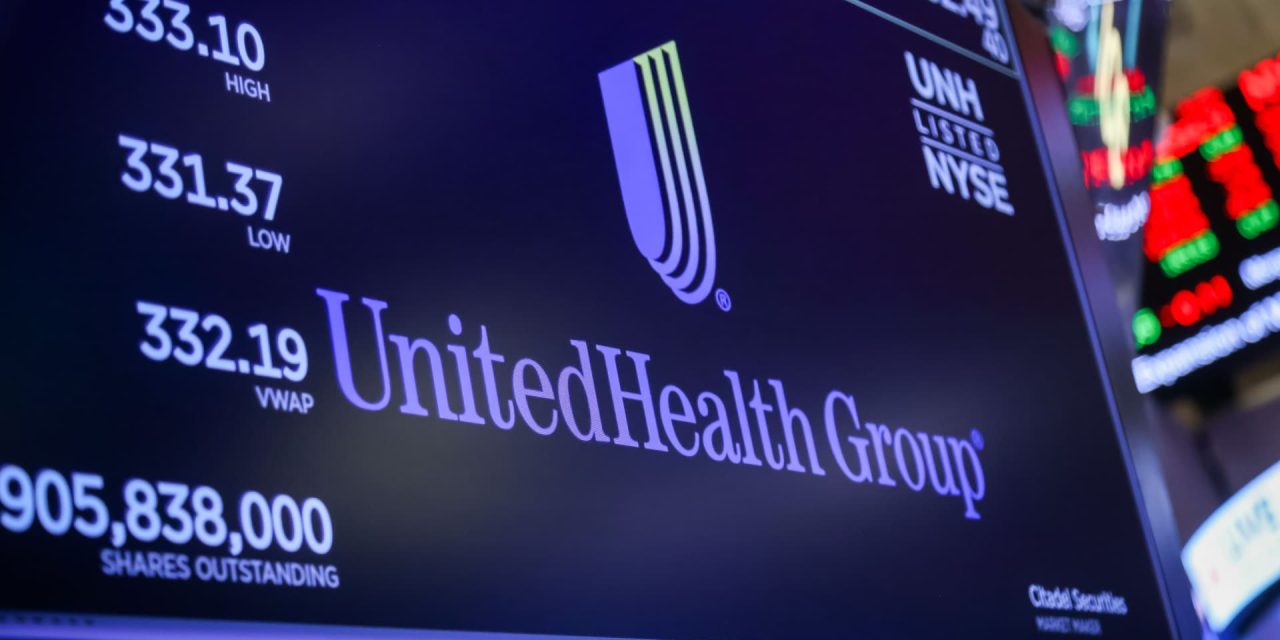
UnitedHealth Group Inc. signage on the floor of the New York Stock Exchange (NYSE) in New York, USA, on Wednesday, December 31, 2025.
Michael Nagle | Bloomberg | Getty Images
UnitedHealth Group reported a slight rise in fourth-quarter profit on Tuesday but issued weak revenue guidance as the parent company of the country’s largest private insurer works to turn around amid higher-than-expected medical costs.
Here’s what the company reported for the fourth quarter compared to Wall Street’s expectations, based on an analyst survey from LSEG:
- Earnings per share: $2.11 adjusted vs. $2.10 expected
- Revenue: $113.2 billion versus expected $113.82 billion
The findings come two days after UnitedHealth CEO Stephen Hemsley and other chief executives of Minnesota’s largest companies banded together to sign an open letter calling for an “immediate de-escalation of tensions” in the state after federal immigration agents fatally shot U.S. citizen Alex Pretti, a 37-year-old intensive care unit nurse.
The company reported fourth-quarter net income of $10 million, or 1 cent per share, compared with $5.54 billion, or $5.98 per share, in the year-ago period. Excluding items such as divestitures, restructuring and costs related to a massive cyberattack on its Change Healthcare division, UnitedHealth earned $2.11 per share.
Sales rose from $100.81 billion in the year-ago quarter.
UnitedHealth is relying on a new leadership team to implement a turnaround plan. The strategy is to shrink membership, raise prices, cut benefits and increase transparency to restore profitability – and the company’s reputation – after a series of hurdles over the past two years.
UnitedHealth expects revenue to exceed $439 billion in 2026, a 2% decline from last year that reflects “right-sizing across the organization,” the company said in a news release. That’s well below the $454.6 billion in sales analysts had expected for the year.
“It’s the first time in a decade that UnitedHealth Group has seen a decline in revenue,” CFO Wayne DeVeydt said in an interview regarding the revenue forecast.
He pointed to three factors that triggered the expected decline, including the company’s divestitures in the fourth quarter and others coming later this year, such as its operations in the United Kingdom and South America. He also pointed to a “pretty significant” decline in total U.S. membership by more than 3 million in 2026.
“I would say that in the fourth quarter we righted the ship in the sense that the tensions, of course, removed us from South America and Europe,” he said. “We are focused on domestic companies in the U.S. and have substantially strengthened the balance sheet and repositioned the company for the historic growth that investors have seen.”
The third factor is that 2026 is the final year of transition to Medicare’s new coding system — known as V28 — which has reduced payments to insurers by changing the weighting of patient diagnoses, DeVeydt said. That will result in a $6 billion decline in revenue, $2 billion of which would come from the company’s insurer, UnitedHealthcare, and the rest from its health care unit, Optum, he noted.
More CNBC Health coverage
On Monday, shares of UnitedHealth and other health insurers plunged after the Centers for Medicare & Medicaid Services proposed near-flat payment rates for insurers under Medicare Advantage, the privately run insurance program that now covers more than half of all Medicare beneficiaries.
This closely watched government payment rate determines how much insurers can charge for the monthly premiums and plan benefits they offer – and ultimately helps shape their profits.
Medical costs for Medicare Advantage patients have skyrocketed in the past two years as more older adults return to hospitals to undergo procedures they had put off during the pandemic, such as joint and hip replacements. In the fourth quarter, those medical costs “were still elevated and high, but did not increase beyond expectations,” DeVeydt said.
For 2026, UnitedHealth expects its insurance segment’s medical benefit ratio – a measure of total medical costs paid relative to premiums collected – to be 88.8%, plus or minus 50 basis points. That would be an improvement over the 89.1% rate reported for 2025. A lower ratio typically indicates that the company collected more in premiums than it paid out in benefits, leading to higher profitability.