












“We’ll meet again”: At the “pajama party” in a bomb shelter in the north of Tel Aviv
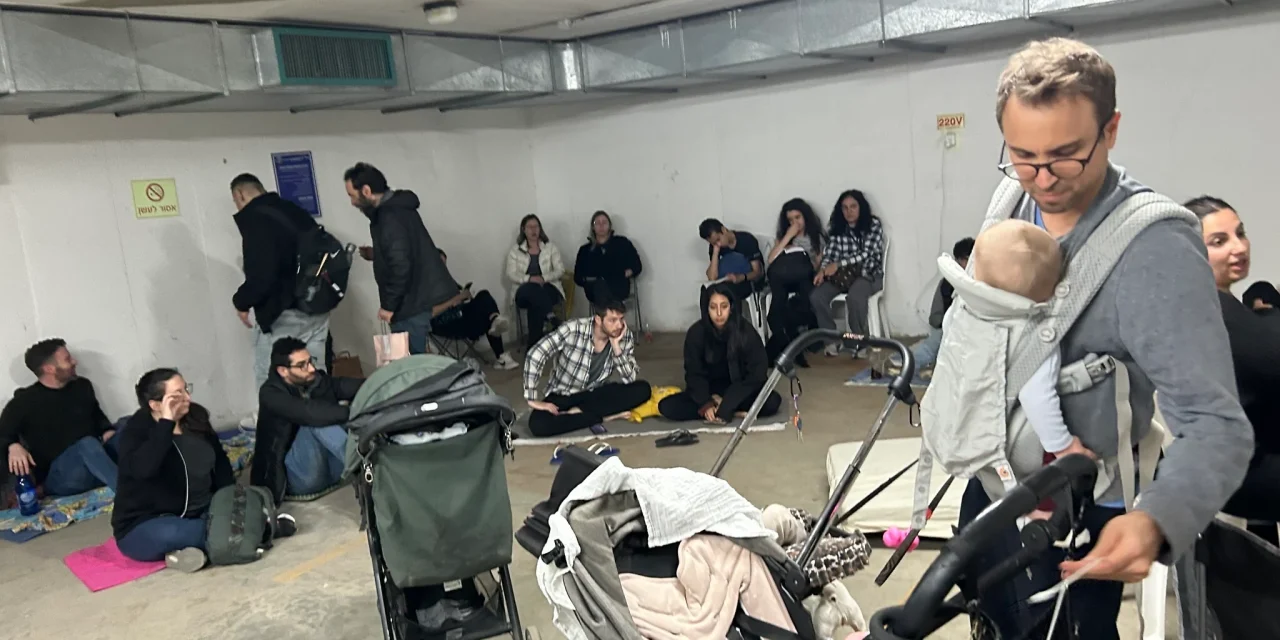
The siren began to wail as Roberto Sciunnach dragged his second mattress down the concrete steps to the shelter, on the side of a cavernous parking lot and two floors below the sprawling Basel Square in north Tel Aviv.
On this temperate Saturday evening, the otherwise busy square above ground was almost empty, the cafes were closed due to a government decree. As Sciunnach descended the stairs – after shouting to his wife that he was nearby, he would make it in time – the accommodation was also almost empty, although that was soon to change.
Within minutes the rooms were bustling with activity as a swarm of adults, children, dogs, strollers, bags, mats and mattresses filled the room. It wasn’t even 7:30 p.m. yet, but families with young children knew now was the time to settle in for the night.
After weeks of anticipation, the war with Iran had finally begun, the second in eight months, plunging the country into uncertainty as sirens blared across Tel Aviv and Israel, warning of incoming Iranian ballistic missiles and drones.
The residents of this shelter came here for safety reasons. But what they found, they said, was the spontaneous community that arises when dozens of Israelis huddle together underground waiting for war. The residents of the shelter came from different countries, brought different foods and had different opinions about the war, but they all united in the hope of a peaceful night.
Get the daily edition of The Times of Israel
by email and never miss our top stories
By registering you agree to the terms and conditions
“We have a full bag of games and we’re making it as normal as possible so the kids don’t feel it,” said Sciunnach, father of a 2-year-old boy and a 6-month-old girl, pointing to a set of MagnaTiles spread out on a mat. “For my son, it’s just a game, a party. If you ask him what he’s doing there, he’s sure it’s a pajama party.”
Sciunnach and his family spent the June War in the shelter of their building, but this felt both safer and more comfortable since they did not have to run up and down the stairs to their apartment every time a siren sounded. They are at the shelter with another young family from their building and ready to settle in for the night, if not longer.
“As a family with two children and a six-month-old baby, it was tough. It wasn’t easy going up and down,” he said. “We chose this shelter at Basler Platz because even if we have a safe room in the building, it is much safer to be two floors below and safety is our top priority.”
People gather in the bomb shelter on Basler Platz in Tel Aviv during a missile alert on February 28, 2026. (Ben Sales/Times of Israel)
Just a few meters away, a group of women sat in a row of lawn chairs lined up against the concrete wall as if on a boardwalk. Two of them, Nelly and Elyane, who declined to give their last names, are both from Belgium but did not know each other before the last Iran war and repeatedly said they were from different cities.
“I met this wonderful neighbor in June,” Nelly said, pointing to Elyane. Then they shouted in unison: “Now we’ll see each other again!”
That’s not the only reason why things are easier for them now.
“It was extremely hot in June. I found it difficult to breathe,” said Nelly. “And we already know. It’s not the first time, so we’re more familiar with the experience.”
She was not against the war, she explained. She hopes that this time the Iranian regime will be overthrown so that Israel doesn’t have to fight another round in a few months.
“I was more anxious before it started, and now that it started, I’m less anxious,” she said. “I’m starting to feel tired, but less anxious.”
“You make faces and generally laugh at the situation.”
Fear and fatigue seemed to be widespread throughout the shelter. Another common feeling: boredom. A group of twenty-somethings sitting on the floor sat almost silently, saying apologetically that they were too tired to do an interview.
Eden, 8 years old, didn’t have a ball under the ground, but he demonstrated a game he and his sister invented: He repeatedly flipped a plastic Coke bottle half filled with water into the air and let it land upright. Several attempts on Saturday evening intended as demonstrations were unsuccessful, but they promised they would have done it sooner.
Later he seemed happier. He pulled a scooter out of a corner of the shelter and made a loop between gaps in the wall.
A man set up a huge pop-up tent in a corner of the bomb shelter at Basel Platz in Tel Aviv on February 28, 2026. (Ben Sales/Times of Israel)
Her father Amir, who also did not give a last name, sat with the family on folding chairs in front of a huge pop-up tent, the roof of which reached up to the accommodation’s air duct. They had spent a night here in June after a previous shelter was flooded with groundwater. This time, he said, he learned his lesson and was better prepared.
“It’s intense and crowded,” he said. But he knows the people here, he added: “It’s the neighborhood, people from the neighborhood.”
A pair of newcomers – a young couple who have moved in together since June – arrived at this shelter after spending the day walking around Tel Aviv. Every time the siren sounded, one of them, named Harel Stavi, said they would find a nearby shelter and stop by.
They were there earlier when Stavi said he managed to order jachnun, a Yemenite Jewish pastry traditionally eaten on weekends, through the popular delivery app Wolt. When the delivery man got there, a siren sounded and he went downstairs for safety reasons. When the shelter was cleared, Stavi said, they found each other and he got his food.
Later, the couple played with some children on a mat near a broken phone.
“We didn’t know anyone,” he said of his roommates. “You make faces and generally laugh at the situation.”
Before the siren sounded at around 7:30 p.m. on February 28, 2026, the large dugout at Baseler Platz was almost empty. (Ben Sales/Times of Israel)
At 8:30 p.m. the shelter was almost empty again. A group of children painted pictures with a mother near Stavi’s location. A room away, Schiunnach fed his children scrambled eggs, peppers and cheese from another family. The mattresses were still leaning against the wall.
A mother told her 6-year-old that she was going outside to smoke and would be right back. They were in for a long night.
Minutes later, Amir, the owner of the huge tent, shouted to a family on mattresses next door that he, too, would run up the steps.
“Bye,” he shouted. “Can I get you something?”